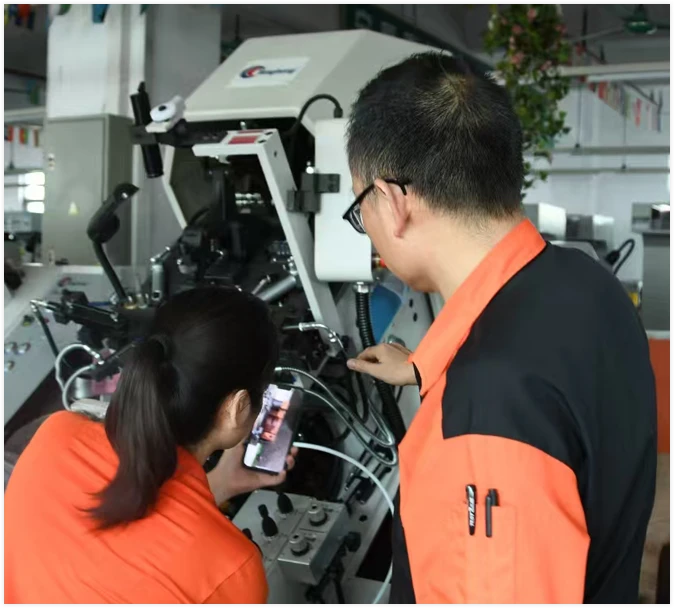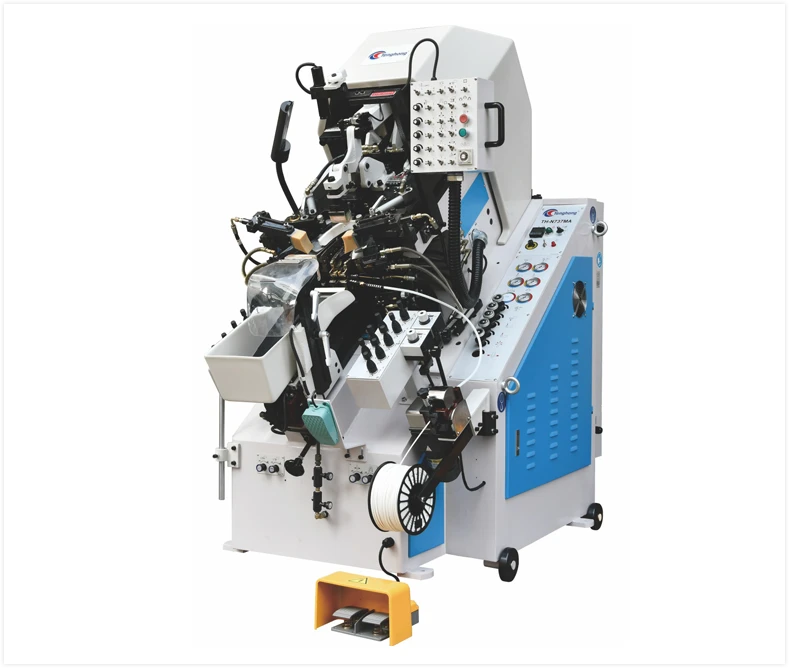
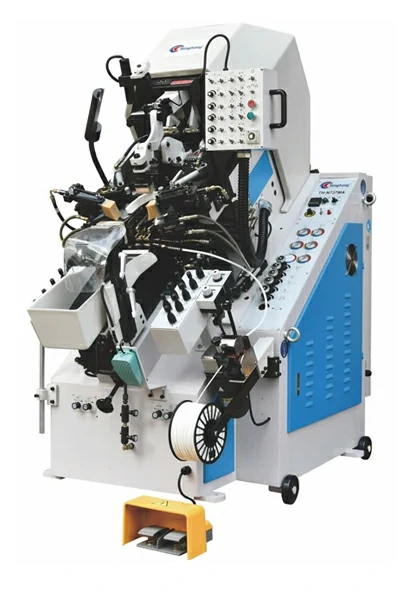
Choosing between a 7-pincer and a 9-pincer toe lasting machine comes down to three operational variables: the curvature of your shoe lasts, your changeover frequency, and your tolerance for manual touch-ups along the feather line. A 7-pincer configuration delivers faster changeovers and lower capital expenditure for round-toe footwear, casual sneakers, and standard work boots. Conversely, a 9-pincer setup provides independent tension control across two additional anchor points, eliminating pleats and voids on sharp-pointed dress shoes, asymmetrical fashion lasts, and high-tensile leather uppers.
This guide evaluates the mechanical differences between both configurations, analyzes how pincer layout impacts lasting quality across specific footwear categories, and provides a structured framework to match the right machine to your production floor.
The Toe Lasting Dilemma: Balancing Fit Precision with Factory Productivity
Forepart lasting defines the structural profile of the shoe. During this operation, the upper material is pulled over the wooden or plastic last, tensioned mechanically, and bonded to the insole using hot-melt adhesive and wiper plates.
If the upper is tensioned unevenly, the margin for error is razor-thin:
- Under-tensioning causes loose vamps and air pockets between the upper and the last.
- Over-tensioning distorts stitch lines, tears delicate grain leather, or misaligns the toe cap.
- Insufficient clamping points force the wipers to gather excessive slack at the corners, creating wrinkles that require manual iron rework.
Factory managers often debate whether jumping to a 9-pincer machine provides genuine quality gains or merely adds unnecessary adjustment complexity for line operators. Selecting the appropriate setup requires examining how clamping force translates across the perimeter of the forepart.
7-Pincer vs. 9-Pincer Toe Lasting Machines: Key Technical Differences
The primary technical distinction lies in how tension is distributed along the transitional zone between the toe tip and the ball girth.
| Last Zone Position | 7-Pincer Machine Array | 9-Pincer Machine Array | Functional Purpose |
| Zone 1: Apex / Toe Tip | Pincer [1] (Center Tip) | Pincer [1] (Center Tip) | Sets longitudinal centerline tension and holds vamp alignment |
| Zone 2: Forepart Corners | Pincers [2], [3] (Left/Right) | Pincers [2], [3] (Left/Right) | Secures front curvature corners around the toe cap radius |
| Zone 3: Lateral Flanks | Pincers [4], [5] (Left/Right) | Pincers [4], [5] (Left/Right) | Pulls sidewalls taut along the forepart edge |
| Zone 4: Rear Forepart | Pincers [6], [7] (Left/Right) | Pincers [6], [7] (Left/Right) | Anchors the back transition of standard round-toe profiles |
| Zone 5: Ball Transition | Not Available (Open Gap) | Pincers [8], [9] (Left/Right) | Eliminates localized slack and draws the edge flat before wipers close |
Pincer Distribution & Clamping Force Distribution
A 7-pincer machine utilizes one central toe pincer, flanked by three pairs of lateral pincers. This array grips the apex of the toe and fans down toward the ball area. The tensile pull is distributed across broad segments of the upper material.
A 9-pincer machine incorporates an extra pair of independently articulated pincers positioned precisely at the transitional curve where the toe profile merges into the waist of the last. This extra clamping zone subdivides the pulling force into smaller increments. By gripping smaller surface areas of the upper, the machine tensions complex contours without over-stretching the central vamp.
Last Contour Adaptability: Curves, Corners, and Edges
Shoe lasts with broad, symmetrical radii distribute wiper pressure evenly across 7 pincers. However, when lasting asymmetrical lasts or designs with tight lateral radii (such as Italian pointed dress shoes or chisel-toe lasts), a 7-pincer layout leaves unsupported gaps between the last corner pincer and the first side pincer.
When the wiper plates close in over unsupported gaps, excess upper material folds rather than draws flat. The two additional pincers on a 9-pincer machine pull this localized slack outward and downward before the wipers make contact, preserving a tight feather line.
Setup Time and Last-Change Flexibility
Operational throughput involves more than machine cycle speed; changeover time between production runs directly impacts daily output:
- 7-Pincer Setup: Involves fewer mechanical contact points. Adjusting pincer opening heights, pull strokes, and angles for a new style or last size requires less downtime, making it advantageous for factories processing frequent short runs of standard casual styles.
- 9-Pincer Setup: Requires fine-tuning two additional pneumatic or hydraulic stroke positions. If an operator misaligns the outer pincers, tension imbalance can pull the shoe upper off-center. Skilled technician adjustment is critical during style changeovers.
| Evaluation Metric | 7-Pincer Toe Lasting Machine | 9-Pincer Toe Lasting Machine |
| Pincer Configuration | 1 central tip pincer + 3 lateral pairs | 1 central tip pincer + 4 lateral pairs |
| Feather-Line Tension Uniformity | Standard; effective on gradual curves | High; isolated control on tight radii |
| Risk of Wrinkling on Complex Lasts | Moderate on sharp or narrow profiles | Low; excess material is pulled flat prior to wiping |
| Changeover & Adjustment Complexity | Lower; faster recalibration for batch changes | Higher; requires balanced calibration across 9 axes |
| Tooling & Wear Components | 7 pincer sets, standard wiper plates | 9 pincer sets, profiled wiper plates |
| Capital Investment Ratio | Baseline | Typically 15% to 30% higher initial equipment cost |
Application Matrix: Matching Pincer Count to Your Footwear Lineup
Equipment selection must align directly with the structural requirements of your product catalog. Investing in an advanced toe lasting machine should address the specific mechanical challenges posed by your upper materials and last geometry.
When a 7-Pincer Machine Is the Smarter Investment
A 7-pincer model remains the workhorse for high-volume production characterized by consistent, rounded geometries:
- Athletic & Running Shoes: Synthetic mesh, engineered knits, and textile uppers possess multi-directional elasticity. These materials conform easily to the last under 7 pulling points without puckering.
- Casual Sneakers & Cup-Sole Shoes: Standard round-toe profiles feature broad radii that wiper mechanisms can close over cleanly.
- Heavy-Duty Work Boots & Safety Footwear: Heavy oil-tanned leather or composite toe caps require concentrated, robust clamping forces rather than delicate lateral contouring.
- Children’s Footwear: The compact dimensions of children’s shoe lasts provide insufficient perimeter space to accommodate 9 distinct pincer heads without physical interference.
When a 9-Pincer Machine Is Essential for Quality
A 9-pincer configuration becomes necessary when lasting footwear where minor cosmetic flaws cause immediate inspection rejections:
- Pointed-Toe & Asymmetric Women’s Fashion Shoes: Sharp toe points create extreme geometric transitions. The eighth and ninth pincers prevent loose pockets along the lateral flanks.
- Men’s Formal Dress Shoes (Oxfords, Derbies): Full-grain calfskin and stiff vegetable-tanned leathers exhibit limited elongation. Nine independent pincers distribute force evenly, preventing surface grain cracking while pulling the edge flat to the insole.
- Narrow-Last Fashion Boots: High-shaft boots require precise vamp tensioning to avoid pulling the throat line out of square. The extended pincer line stabilizes the upper against the cone of the last.
Cost vs. ROI: Calculating Total Ownership Beyond Purchase Price
Evaluating machinery purely by the initial purchase invoice often overlooks downstream labor and quality expenses.
1. Equipment CapEx and Wear-Part Replacement
A 7-pincer machine carries lower initial acquisition costs and fewer mechanical wear points. Jaws, pneumatic seals, and flexible linkages must eventually be replaced. A 9-pincer machine adds two complete pincer assemblies, increasing ongoing preventative maintenance and spare-part stocking requirements.
2. Labor Skill Requirements
Operating a 7-pincer unit is simpler to standardize across shifts. Operators with basic machine training can monitor alignment and manage standard runs. A 9-pincer unit requires an experienced technician who understands how adjusting pincer #8 affects tension at pincer #3. Poor calibration can stretch leather unevenly, creating asymmetrical toe caps.
3. Scrap Rates and Secondary Ironing Labor
Where the 9-pincer machine generates a quantifiable return on investment is in the finishing room. On premium leather lines, a 7-pincer machine may leave small pleats around the toe perimeter that require operators to manually flame, iron, or hammer out before sole attaching. If a 9-pincer unit eliminates two minutes of post-lasting touch-up per pair on a line producing 1,200 pairs daily, the reduction in labor and rework readily offsets the higher machine price point.
Buyer’s Checklist: 4 Steps to Select the Right Machine for Your Plant
Use this operational framework before issuing a request for quotation (RFQ):
- Audit Your Dominant Last Curvatures
- If >70% of your production volume consists of round-toe, wide-toe, or sneaker lasts, a 7-pincer machine delivers sufficient mechanical precision.
- If your catalog incorporates pointed, square-chisel, or high-taper fashion lasts, prioritize a 9-pincer layout.
- Evaluate Upper Material Compliance
- High-stretch materials (synthetics, canvas, soft suede) pull smooth with fewer clamping points.
- Low-stretch, temperamental materials (stiff crust leather, patent leather, high-tensile coated materials) require more clamping points to distribute load without tearing.
- Calculate Daily Batch Frequency
- High-volume manufacturing lines running the same last profile for weeks at a time can justify the extended setup time required to dial in a 9-pincer system.
- Contract manufacturers running multiple short-run style changes per day often benefit from the rapid changeover capabilities of a 7-pincer unit.
- Plan for Catalog Expansion
- If your factory plans to transition from sports footwear into higher-margin dress shoes or structured leather boots within the next 24 to 36 months, a 9-pincer platform provides the geometric flexibility needed to support that transition.
Optimize Your Lasting Line with Tenghong Machinery
Selecting the correct lasting configuration directly impacts daily line balance, reject rates, and finished shoe structural integrity. Tenghong manufactures precision shoemaking equipment engineered for stable hydraulic pressure, smooth wiper transitions, and intuitive pincer adjustments across diverse footwear categories.
Review our technical configurations and evaluate machine specifications on the official Tenghong toe lasting machine product portal.
Key Takeaways
- Core Difference: A 7-pincer toe lasting machine uses three lateral pairs of clamping jaws for uniform, standard lasts, while a 9-pincer machine adds a fourth lateral pair to manage complex contours and prevent perimeter wrinkling.
- Best for 7-Pincers: Athletic sneakers, children’s shoes, work boots, and high-frequency short-run production using flexible materials.
- Best for 9-Pincers: Formal leather dress shoes, pointed-toe fashion heels, and stiff leathers requiring precise tension control along the ball transition.
- Operational Trade-off: 7-pincer units offer faster changeovers and lower maintenance overhead; 9-pincer units require more calibration skill but significantly reduce downstream manual ironing and scrap rates on complex styles.
FAQ
Can a 7-pincer toe lasting machine be upgraded to a 9-pincer machine later?
In most industrial models, converting a 7-pincer machine to a 9-pincer setup is mechanically impractical. The main casting, hydraulic/pneumatic manifold blocks, valve configurations, and wiper drive housings are designed specifically for the original pincer count. Factories anticipating more complex shoe profiles should evaluate a 9-pincer platform initially or plan for a dedicated machine addition.
Does a 9-pincer machine use significantly more hydraulic or pneumatic power?
Power consumption differences between 7- and 9-pincer machines are generally negligible in standard factory operations. The hydraulic pump motor sizing remains comparable across standard platforms. The primary difference lies in the distribution of hydraulic or pneumatic fluid through two additional actuator circuits, not in the base electrical demand of the motor.
How do I know if lasting defects are caused by pincer count or incorrect wiper temperature?
Inspect the defect pattern along the shoe feather line:
- Wrinkles with loose material extending up the vamp: Typically indicates insufficient pincer tension or an inadequate pincer count failing to hold the upper firm against the last curvature.
- Upper material tearing or rough, fractured edges at the insole boundary: Often indicates excessive pincer pull tension, improper pincer serration grip, or cold wiper plates failing to melt the adhesive cleanly.
- Adhesive release after lasting: Usually caused by incorrect wiper plate temperature settings, improper adhesive open-time, or insufficient wiper hold dwell time rather than pincer layout.