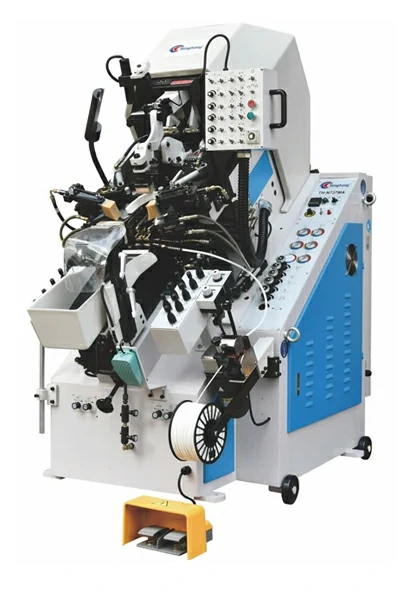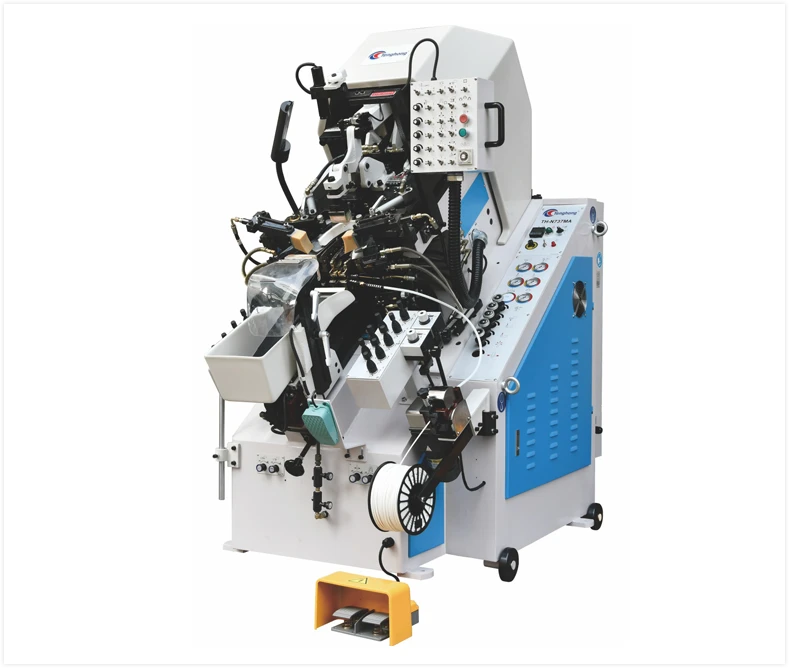
Selecting between a hydraulic and a servo-driven toe lasting machine determines a footwear plant’s long-term utility overhead, lasting scrap rates, and tooling adaptability.
Directly compared, hydraulic systems deliver high mechanical clamping force at a lower initial purchase price, but they continuously draw idle power and suffer from hydraulic fluid viscosity changes across multi-shift runs. Servo-driven toe lasting units replace hydraulic pumps with precision servo motors, ball screws, and digital encoders. This architecture cuts continuous power consumption by supplying force strictly on demand, eliminates thermal drift to protect delicate uppers, and reduces regular fluid maintenance.
Evaluating the right drive architecture requires measuring your local electricity tariffs, production switchover frequency, shoe upper material sensitivity, and total cost of ownership (TCO).
Core Mechanical Differences: How Hydraulic and Servo Systems Drive the Lasting Process
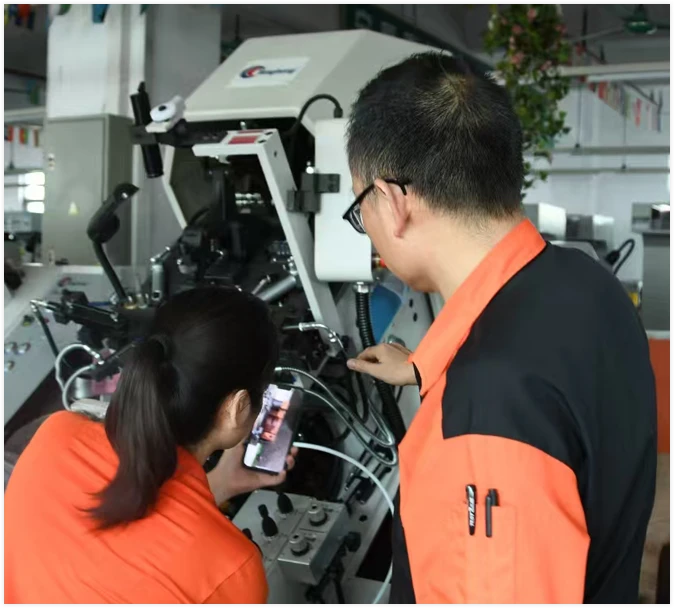
The toe lasting process requires simultaneous multi-axis motion: pincer groups pull the upper material over the shoe last, the support block raises to seat the assembly, and the wiper plates advance inward to flatten and bond the margin onto the insole. How mechanical force is generated across these steps defines the operational envelope of each machine class.
Hydraulic System Architecture
Conventional hydraulic toe lasting machinery depends on an electric motor continuously turning an internal gear or vane pump to circulate hydraulic oil through a manifold block. Directional solenoid valves, proportional pressure valves, and hydraulic cylinders actuate the pincer jaws and wiper heads. Because fluid dynamics govern stroke and pressure, continuous system pressure must be maintained even while the operator positions the shoe last.
Servo-Driven System Architecture
A servo-driven machine replaces fluid pressure circuits with independent AC servo motors coupled to precision ball screws, timing belts, or direct-drive planetary gearboxes. Each axis—such as pincer pull tension, wiper travel stroke, and vertical last support—is managed by an individual digital drive with absolute encoder feedback. Closed-loop feedback monitors mechanical displacement and applied torque thousands of times per second, executing exact positioning without hydraulic fluid intermediaries.
Drive Architecture & Mechanical Transmission Comparison
| System Element | Hydraulic Drive Architecture | Servo-Driven Drive Architecture |
| Power Conversion | Continuous electric motor driving a fluid gear/vane pump | Dedicated AC brushless servo motors on active axes |
| Motion Transmission | Pressurized fluid routed via manifolds, valves, and cylinders | Direct ball screws, planetary reducers, or timing belt drives |
| Position Feedback | Limit switches or analog stroke sensors (open/semi-closed loop) | High-resolution absolute optical/magnetic encoders (closed loop) |
| Force Control Mode | System fluid pressure regulated via proportional relief valves | Real-time motor torque limit curves and current feedback |
| Idle Energy Behavior | Continuous fluid recirculation through bypass circuit generating heat | Motor at zero velocity drawing minimal quiescent standby power |
Energy Efficiency Analysis: Real-World Power Consumption Compared
Utility expenses represent one of the highest continuous operating expenditures in automated footwear assembly lines. The energy consumption profile differs fundamentally between hydraulic and servo architectures due to how motor loads are managed during the working cycle.
Comparative Load Cycle by Operating Phase
| Operating Stage | Hydraulic Load Characteristics | Servo-Driven Load Characteristics |
| Idle / Shoe Last Loading | Draws 40% to 60% base electrical load continuously to bypass oil | Consumes 0% to 5% nominal standby power for control electronics |
| Active Tensioning & Lasting | Operates at 100% full pump capacity with excess vented via valves | Delivers scaled, dynamic load matching target pincer/wiper torque |
| Stroke Reversal & Reset | Valve spools switch direction under sustained line fluid pressure | Kinetic energy recovery via dynamic deceleration braking |
| Auxiliary Overhead | Requires continuous oil chiller or heat exchanger cycling | Zero dedicated cooling circuit; ambient cabinet heat venting |
1. Idle Energy Losses
In standard hydraulic machines, the hydraulic pump motor runs continuously throughout the work shift. Even when the machine rests in an idle state while an operator inspects an upper, trims excess material, or mounts the shoe last onto the support column, the motor draws baseline grid power to recirculate fluid through relief valves back to the reservoir.
In contrast, a servo motor draws only nominal standby current to maintain encoder positioning when the machine is waiting. Mechanical work and electrical draw occur strictly during active pincer tensioning, bed elevation, and wiper sweeps.
2. Thermal Conversion and Auxiliary Cooling
Fluid friction inside hydraulic lines, manifolds, and restrictive throttling valves converts hydraulic pressure into heat. As oil reservoir temperatures climb during multi-shift operations, factories must frequently run auxiliary water chillers or oil-cooling heat exchangers, compounding overall electricity usage.
Servo systems bypass fluid friction entirely, venting minimal ambient heat through drive heat sinks and avoiding supplemental line-chilling infrastructure.
| Operating Parameter | Hydraulic Toe Lasting System | Servo-Driven Toe Lasting System |
| Idle State Power Draw | Moderate to high (continuous pump idle) | Negligible (quiescent control power only) |
| Active Stroke Delivery | Regulated via throttling / bypass valves | Direct torque output proportional to demand |
| Thermal Dissipation | High fluid heat; often requires oil cooling | Low mechanical heat dissipation |
| Cycle Responsiveness | Limited by valve spool shift speed | Millisecond-level acceleration and braking |
| Energy Profile Assessment | Baseline load remains fixed regardless of output | Power draw scales linearly with daily pairs produced |
For factories operating multiple shifts in regions with escalating commercial power rates, upgrading to energy-efficient shoe lasting machinery significantly curbs daily kilowatt-hour demand per pair produced.
Precision and Lasting Quality: Wiper Action and Pincer Tension Accuracy
Lasting quality is evaluated by consistent margin feather lines, tight feather edges around the toe box, and zero vamp tearing. Material deformation during lasting must match the shoe last contour without over-stretching structural grain or distorting synthetic stitch lines.
Material Behavior Under Lasting Tension
| Material Category | Hydraulic Tensioning Outcome | Servo-Driven Tensioning Outcome |
| Full-Grain & Aniline Leather | Risk of sudden over-travel if valve sticks, causing grain rupture | Programmable torque ceiling limits tensile stress to prevent tears |
| Engineered Mesh & Knits | Difficult to regulate clamping softness; risks slip or laddering | Digital clamping control maintains grip without crushing filaments |
| Synthetic Microfibers | Inconsistent elongation across fluctuating shift temperatures | Repeatable position-controlled stroke yields identical margins |
| Heavy Split / Work Leather | Delivers strong clamping, though edge feathering can wander | Synchronized wiper progression produces consistent edge roll-over |
Pincer Pull Control: Avoiding Vamp Tearing and Wrinkling
Hydraulic pincers rely on line pressure settings adjusted via manual knobs or analog proportional valves. Because hydraulic cylinders actuate against fluid compressibility and seal friction, fine micro-adjustments across individual pincer pairs are difficult to stabilize.
Servo-driven pincers allow operators to program digital stroke profiles, pull velocity, and target holding torque per clamp. When pulling delicate calfskin, high-stretch mesh, or thin synthetic microfiber, the servo drive dynamically limits tensile load, eliminating local strain points that cause torn vamps or uneven toe caps.
Temperature Drift and Consistency Across Shift Changes
A common defect pattern in hydraulic lasting rooms involves dimensional drift between the morning start and late afternoon:
- Cold Starts: When oil is cold, viscosity is high, resulting in slightly slower wiper movement and stiffer pressure curves.
- Mid-Shift Run: As oil temperature climbs past normal thresholds, fluid thins, causing internal valve leakage, reduced clamping pressure, and incomplete wiper sweeps.
Servo systems rely on digital positions recorded by high-resolution encoders mounted to mechanical drives. The exact travel distance, wiper height, and sweeping curvature remain identical on cycle 1,000 as on cycle 1, regardless of room or machine temperature.
Maintenance Realities: Hydraulic Leaks vs. Electronic Reliability
Unscheduled downtime interrupts the pacing of downstream bottom cementers, heel lasters, and chilling tunnels. The mechanical differences between hydraulic and servo systems dictate distinct preventative maintenance workflows.
Maintenance & Workplace Footprint Comparison
| Inspection Factor | Hydraulic Toe Lasting System | Servo-Driven Toe Lasting System |
| Scheduled Consumables | Hydraulic oil flushes, return filters, suction strainers | Standard industrial guide rail and ball screw grease |
| Mechanical Wear Points | Piston rod O-rings, dynamic cylinder seals, hose crimps | Linear bearings, ball screw nuts, drive belts |
| Workplace Cleanliness | Potential micro-leaks, oil mist, floor pan residue | Dry, oil-free mechanical cabinet and tooling zone |
| Product Contamination Risk | Airborne or dripping oil can permanently stain light uppers | Zero fluid hazard; compliant with strict cleanroom audits |
| Troubleshooting Process | Manometer checks, valve teardowns, fluid leak tracing | On-screen PLC drive diagnostics, error codes, bus telemetry |
Hydraulic Maintenance Realities
Maintaining a hydraulic toe lasting machine involves hydraulic fluid stewardship:
- Periodic oil reservoir drainage and fluid disposal
- Inline return-filter and suction-strainer replacements
- Monitoring hose fatigue, fitting micro-leaks, and manifold seals
- Replacing piston rod O-rings and cylinder packing seals degraded by mechanical friction and oil breakdown
Fluid leaks pose direct product contamination hazards: oil mist or dripping fluid on lasting room floors can stain light-colored leather, nubuck, or textile uppers, creating irreversible scrap.
Servo-Driven Mechanical Reliability
Eliminating the hydraulic power unit removes fluid reservoirs, high-pressure flexible hoses, directional valves, and dynamic cylinder seals. Routine servicing centers on standard mechanical and electrical maintenance:
- Scheduled grease replenishment along linear guide rails and ball screw nuts
- Checking drive belt tension (where applicable)
- Keeping control cabinet cooling fans and dust filters clear of airborne leather dust and cementing vapors
The clean mechanical layout creates a dry, oil-free workstation suitable for meeting demanding customer facility audits and cleanroom footwear manufacturing standards.
Financial Breakdown: Initial CAPEX vs. Long-Term Total Cost of Ownership (TCO)
Procurement teams must weigh initial purchase outlays against lifetime operational costs. A machine with a lower acquisition cost can incur significantly higher lifetime expenses if it draws excess power and yields higher scrap rates.
$$\text{TCO} = \text{CAPEX (Purchase Price)} + \text{OPEX (Multi-Year Power)} + \text{Maintenance (Fluids, Wear Parts, Labor)} + \text{Scrap Loss (Material Rejection)}$$
Estimated Cost Component Share Over Equipment Lifespan
| Cost Category | Hydraulic Toe Lasting Machine | Servo-Driven Toe Lasting Machine |
| Initial Acquisition (CAPEX) | 30% – 40% of total lifecycle spend | 50% – 60% of total lifecycle spend |
| Electrical Power (OPEX) | 35% – 45% (Continuous idle draw + chillers) | 15% – 20% (Power on demand + dynamic recovery) |
| Maintenance, Consumables & Scrap | 20% – 25% (Oil, filters, seals, stained uppers) | 10% – 15% (Lubrication greasing, minimal scrap) |
Capital Expenditure (CAPEX)
Hydraulic toe lasting machines represent mature, highly standardized manufacturing technology. The parts, valves, and cylinders are widely manufactured, keeping the upfront unit price lower.
Servo-driven toe lasting units command a higher initial capital investment due to the cost of multi-axis servo motors, digital amplifiers, motion controllers, and precision ground ball screws.
Operational Expenditure (OPEX) and Payback Factors
To determine the payback period of a servo upgrade, calculate the variance across three primary factors:
$$\text{Annual Net Savings} = \Delta \text{Energy Costs} + \Delta \text{Maintenance Outlays} + \Delta \text{Yield Savings}$$
- Power Consumption Variance ($\Delta \text{Energy}$): Measure the differential between continuous motor run times versus intermittent duty-cycle servo operation based on local industrial kWh rates and shift lengths.
- Maintenance and Consumables ($\Delta \text{Maintenance}$): Account for eliminated annual oil purchases, fluid waste handling fees, filter replacements, and seal repair labor.
- Scrap and Rework Reductions ($\Delta \text{Yield}$): In premium leather dress shoe or athletic footwear production, saving even a fraction of a percent in upper tearing and oil-stain rejection translates to substantial material cost preservation over thousands of production pairs.
Factories evaluating a line overhaul can inspect modern Tenghong toe lasting machine models to review specific drive configurations, kinematic layouts, and mechanical footprints.
Decision Matrix: When to Choose Hydraulic vs. When to Upgrade to Servo
Neither technology fits every footwear production environment universally. The ideal selection depends on batch scale, shoe style complexity, operator skill levels, and factory infrastructure.
Factory Selection Matrix
| Factory Profile & Requirements | Recommended Machine Type | Key Selection Rationale |
| High-Volume Contract Manufacturer Standardized running shoes, multi-shift, high local power rates | Servo-Driven | Maximizes energy savings across 16–24 daily operating hours; ensures uniform toe profiles across high-volume production. |
| Luxury / Premium Leather Footwear High-grade calfskin, thin leathers, delicate dress lasts | Servo-Driven | Closed-loop torque feedback prevents grain overstretching and vamp tearing; zero oil mist avoids staining expensive uppers. |
| Heavy-Duty Work Boot & Safety Footwear Thick leathers (2.0mm+), rigid toe counters, steel toe inserts | Heavy Hydraulic | High continuous hydraulic clamp force handles heavy leather shaping at a lower initial equipment cost. |
| Cost-Sensitive Regional Producer Stable local power costs, established hydraulic maintenance team | Hydraulic | Lower initial capital outlay; repairs can be handled in-house using standard hydraulic replacement parts. |
| Flexible / Quick-Response Factory Frequent style switchovers, small batch runs, multiple shoe lasts | Servo-Driven | Digital recipe storage allows instant recall of pincer positions and wiper trajectories without manual valve tuning. |
Key Takeaways
- Drive Architecture: Hydraulic units rely on continuous fluid pump circulation and valve distribution; servo models use closed-loop digital AC motors and ball screws that draw significant power only while in motion.
- Energy Consumption: Servo-driven machinery eliminates the idle energy consumption of continuously running hydraulic pumps, making it well-suited for high-tariff industrial zones.
- Forming Precision: Servo systems prevent stroke deviations caused by rising hydraulic oil temperatures, ensuring consistent wiper movement and tension control across all operating shifts.
- Maintenance & Cleanliness: Servo designs eliminate hydraulic oil, filters, and dynamic cylinder seals, removing the risk of oil-stained shoe uppers and easing facility compliance.
- Investment Payback: While hydraulic systems require lower initial CAPEX, servo machinery offsets its purchase premium through utility savings, reduced scrap, and shorter changeover times.
Frequently Asked Questions (FAQ)
Can an existing hydraulic toe lasting machine be retrofitted with a servo drive?
While retrofitting an external variable-frequency drive (VFD) onto a hydraulic pump motor is possible to regulate idle pump speed, fully converting a hydraulic machine’s cylinders and proportional valves to servo ball screws is generally not cost-effective. The mechanical chassis, casting points, and control PLC architecture are fundamentally different. Investing in a purpose-built servo machine is typically more economical and structurally reliable.
Do servo toe lasting machines require specialized technicians for daily calibration?
No. Daily operation of a servo machine is often simpler for line operators than a hydraulic equivalent. Once lasting parameters (pincer drop distance, holding torque, wiper curve) are programmed for a specific shoe last, they are stored as digital production recipes. Operators recall the program via a touchscreen interface without manually adjusting hydraulic valve knobs or balancing pressure gauges.
How does ambient factory temperature affect hydraulic toe lasting performance?
Ambient factory temperatures directly influence hydraulic fluid viscosity. Cold morning temperatures make oil sluggish, yielding slower pincer movements and stiff wiper strokes. As the machine runs and ambient temperature climbs, oil viscosity drops, which can lead to internal valve leakage, fluctuating pincer tension, and irregular lasting margins unless compensated for by active oil chillers.
What parameters should be confirmed with the machinery supplier before ordering?
Procurement teams should confirm the maximum pincer opening stroke, number of independent pincer sets, wiper heating block temperature ranges, compatibility with specific shoe last sizes (e.g., children’s shoes vs. oversized men’s work boots), power supply voltages, and whether the system provides digital recipe management for rapid tooling changeovers.
Upgrading Your Lasting Line with Tenghong Machinery
Balancing initial machinery expenditure with multi-year operating margins determines whether your lasting room remains competitive as utility rates and material costs rise.
Whether your manufacturing setup requires the high-tonnage forming capacity of an industrial hydraulic machine or the energy-saving digital precision of a modern servo system, reviewing technical equipment layouts is the critical first step. Contact the engineering sales team at Tenghong to review cycle specifications, request tooling footprint diagrams, or calculate a custom operational payback profile for your production line.