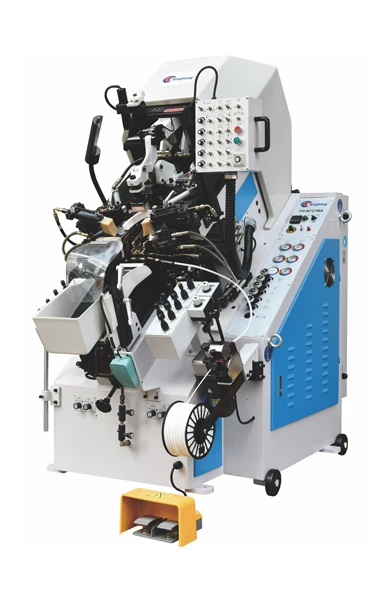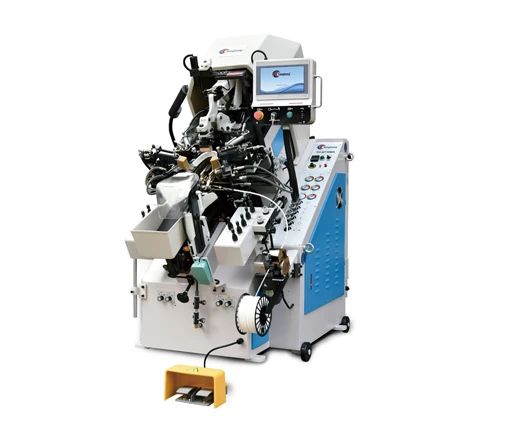
Toe lasting for safety shoes presents a far narrower operating window than lasting standard leather shoes or athletic footwear. Integrating rigid internal protective caps—whether steel or non-metallic composite—radially changes how the upper leather stretches, how thermal cement bonds, and how mechanical wipers shape the featherline. Achieving a clean, wrinkle-free safety shoe toe requires matching pincer tension profiles, multi-stage wiper strokes, and controlled thermal dwell times to the specific structural properties of the cap material.
Selecting and configuring a dedicated toe lasting machine for safety shoes depends heavily on cap rigidity, transition-edge thickness, and thermal responsiveness. This guide breaks down the structural differences between steel and composite toe caps, analyzes the root causes of common lasting defects, outlines critical machine engineering requirements, and provides actionable setup steps for production lines.
Why Safety Shoe Toe Lasting Demands Higher Precision than Casual Footwear
In conventional footwear lasting, the vamp material conforms directly over a soft or semi-rigid counter across the curvature of the shoe last. Safety footwear, by contrast, sandwiches an unyielding protective shell between the upper leather and the lining.
This rigid shell introduces three distinct production constraints:
- Zero Lasting Elasticity at the Tip: Steel and composite caps cannot stretch or yield under pincer tension. The upper leather must be drawn taut across a hard, non-deformable dome without tearing or generating localized thinning.
- The Transition-Step Discontinuity: The rear boundary where the protective cap meets the unsupported upper creates an abrupt drop in profile. Standard wipers traversing this zone frequently leave loose featherline folds or pinch marks if closing geometry is unadjusted.
- Adhesion Barriers: Protective inserts act as thermal sinks or thermal barriers, altering how hot-melt adhesives cool and solidify before lasting pressure fully consolidates the bond.
Failure to resolve these mechanical constraints leads to high defect rates at the lasting station and risks failing structural impact or compression requirements if the cap shifts off-center during pulling.
Steel vs. Composite Toe Caps: Understanding the Structural Differences in the Lasting Cycle
The physical properties of the protective insert dictate the mechanical force and thermal settings required during the lasting cycle. Steel and non-metallic composite caps behave differently under mechanical clamp load and heat.
| Comparison Parameter | Steel Toe Caps | Composite Toe Caps (Fiberglass / Carbon / Plastic) |
| Material Elasticity & Flex | Extremely rigid; zero elastic recovery under lasting loads | Slight elasticity; exhibits spring-back if forming pressure is removed prematurely |
| Edge Profile & Thickness | Thin cross-section; sharp transition ridge to upper | Thicker cross-section to meet equivalent impact ratings; blunt, pronounced transition ridge |
| Thermal Characteristics | High thermal conductivity; pulls heat away from hot-melt cement rapidly | Acts as a thermal insulator; slow heat dissipation through the shoe interior |
| Primary Lasting Challenge | Upper pinch tearing along the sharp rear edge; rapid adhesive premature setup | Cap deformation from excessive localized heat; featherline wrinkles caused by thick cap edges |
| Recommended Wiper Action | Rapid, high-tonnage sweep and firm flat press | Progressive two-stage wiping with sustained dwell pressure to manage spring-back |
Mechanical Impacts of Steel Inserts
Steel caps offer a very low profile due to the high density and strength of the metal. However, this creates a defined, sharp step at the feather edge. If pincer jaws pull the leather obliquely over this border, localized shear forces can cut through light or split leather linings. Furthermore, cold steel draws heat out of applied hot-melt cement almost instantly, which requires short cycle intervals between adhesive application and wiper consolidation.
Mechanical Impacts of Composite Inserts
Composite inserts—commonly made of woven fiberglass, carbon fiber blends, or impact-resistant polymers—require thicker cross-sections to pass standard EN ISO 20345 or ASTM F2413 impact tests. This bulkier geometry magnifies the transition step between the cap and the vamp. When the lasting wiper closes, excess upper volume easily bunches at the corners of the cap. Composite materials also have lower heat deformation thresholds, meaning excessive hot-air reactivation temperatures can soften or compromise the cap shell.
Overcoming Critical Lasting Defects on Rigid Toe Profiles
Managing rigid safety components requires adjusting how mechanical elements interact with the shoe last at specific moments in the cycle.
Eliminating Featherline Wrinkles and Upper Pinch Marks around Thick Edges
Featherline wrinkles occur when the wiper plates push excess material inward without sufficient downward tension from the pincer group. On safety boots with thick composite caps, standard wiper plates slide over the cap crown without firmly pressing the base radius.
To resolve this:
- Incorporate auxiliary side-press pads or contoured wiper inserts that match the curvature of the safety last.
- Configure the pincer pull sequence so that the corner pincers maintain tension while the center wipers begin their inward sweep, feeding slack material uniformly under the insole margin.
Preventing Toe Cap Shifting and Asymmetry During Pincer Pulling
A protective cap must remain centered over the lasting axis. If lateral pincers pull unevenly, the cap can rotate or slide back toward the waist, compromising toe clearance inside the finished shoe.
To resolve this:
- Verify that mechanical last-support posts seat firmly under the forepart, stabilizing the last against horizontal thrust.
- Employ programmable, independent pincer groups that allow operators to balance left-and-right gripping tension independently, compensating for asymmetric work boot profiles.
Securing Uniform Adhesive Penetration Without Delamination
When cement cures before the wiper completes its stroke, the margin de-bonds immediately after the shoe is un-lasted.
To resolve this:
- Balance adhesive open time with lasting cycle duration.
- Ensure the safety shoe toe lasting machine provides sufficient bed-plate temperature regulation and adjustable consolidation dwell times, giving the adhesive enough interval under continuous pressure to wet both the upper substrate and insole surface.
Key Machine Features Required for High-Performance Safety Shoe Toe Lasting
Standard utility lasting machines built for lightweight dress shoes lack the structural rigidity and hydraulic force required for heavy-gauge work footwear. Modern safety footwear lines rely on specific engineering features to maintain consistent output.
- Multi-Point Micro-Adjustable Pincer Groups: Handling stiff upper leathers, heavy linings, and impermeable membranes requires robust pincer assemblies. Look for systems featuring independent pincer positioning and individual pressure regulators. This allows technicians to fine-tune gripping force near sensitive cap corners without tearing the material.
- Two-Stage Wiper Motion with Independent Pressure Regulation: A two-stroke wiper action is critical for safety shoe profiles. The initial stroke draws the upper over the cap edge at a controlled advance speed; the second stroke ramps up hydraulic pressure to iron out wrinkles and seat the lasted margin flatly against the insole.
- Heated Wiper Heads and Contoured Auxiliary Pushers: Wiper heating elements ensure thermal cement remains workable throughout the mechanical sweep. Auxiliary hydraulic pushers positioned directly over the toe cap profile prevent the front edge of the shoe from lifting upward under wiper friction.
- Rigid Machine Frame and Stabilized Last Post: The combined resistance of safety uppers, thick linings, and heavy insoles generates high vertical and horizontal reaction forces. Reinforced machine framing prevents chassis deflection, ensuring pincer stroke accuracy down to the millimeter.
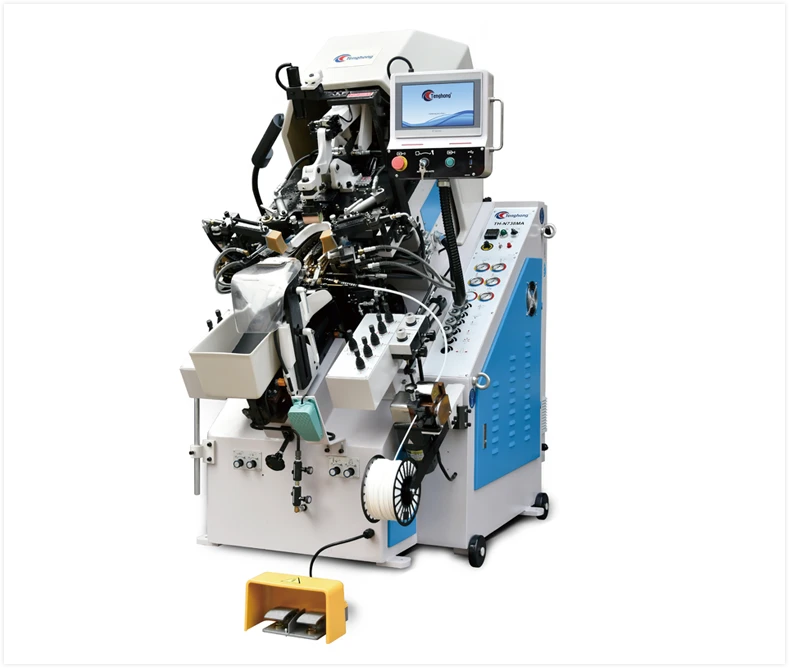
Evaluating equipment such as a dedicated Tenghong toe lasting machine allows manufacturing teams to assess whether hydraulic ratings, wiper travel profiles, and pincer stroke controls align with their specific safety shoe upper construction.
Step-by-Step Optimization: Setting Up Your Lasting Line for Safety Boots
Establishing a repeatable process window minimizes changeover scrap and keeps defect levels predictable across shifts.
| Stage | Process Step | Focus Area | Technical Execution & Controls |
| 01 | Cap Alignment | Pre-lasting attachment | Verify that toe caps are securely spot-glued or taped to the vamp lining prior to lasting to prevent rotational drift during mechanical pulling. |
| 02 | Thermal Prep | Conditioning & reactivation | Calibrate steaming and pre-heating units to ensure leather suppleness without exceeding the deformation temperature of composite caps or internal counters. |
| 03 | Pincer Balancing | Multi-point tensioning | Set the front pincer group to draw slightly ahead of lateral pincers, seating the cap firmly onto the last crown before side clamps close. |
| 04 | Wiper Sweep & Dwell | Margin consolidation | Guide wiper plates along last-matched contours, holding final hydraulic pressure through a calibrated dwell time to eliminate spring-back and lock the adhesive bond. |
Frequently Asked Questions
Can one toe lasting machine run both steel and composite safety shoes on the same line?
Yes, provided the machine features quick-change wiper mechanisms, programmable cycle recipes, and independent pincer pressure controls. Because composite caps are typically bulkier than steel caps, operators must adjust wiper travel limits and pincer opening clearances when switching styles.
How do you prevent leather from tearing along the rear edge of a steel toe cap?
Tearing is usually caused by excessive vertical pincer draw, mismatched pincer angles, or unskived leather edges. Reducing the primary pincer pull force, beveling the internal lining margin, and ensuring the rear edge of the steel cap includes a smooth protective rubber strip will prevent the upper from shearing.
Why does the featherline wrinkle more noticeably on asymmetric safety shoes?
Asymmetric safety shoes feature uneven curvature between the medial and lateral sides of the forefoot. If the wiper plates move symmetrically across an asymmetrical last, the wiper strikes the wider side prematurely while leaving excess slack on the narrower side. Utilizing independently adjustable split wipers or last-specific tooling resolves this imbalance.
Engineering Consultation for Safety Footwear Production
Overcoming lasting issues on heavy safety footwear requires coordinating material properties with mechanical machine controls. Balancing pincer tension profiles, thermal activation, and wiper closing pressures eliminates costly defects such as loose featherlines, asymmetric caps, and delamination.
Manufacturers experiencing high rejection rates or planning line upgrades can contact Tenghong’s technical team to review shoe profiles, last geometries, and machinery configurations tailored to rigid cap lasting operations.
Key Takeaways
- Material-Driven Setup: Steel caps act as thermal sinks requiring rapid adhesive consolidation; composite caps are bulkier and more prone to spring-back, requiring extended wiper dwell times.
- Core Defect Mechanisms: Featherline wrinkling and cap shifting stem from uncoordinated pincer pulling and inadequate wiper adaptation across the cap transition step.
- Machine Prerequisites: Efficient production demands a machine featuring independent multi-pincer adjustment, two-stage wiper cycles, and rigid frame construction to resist safety-grade hydraulic pressures.
- Process Stability: Standardizing spot-gluing alignment, balancing lateral pincer draw, and matching wiper plate contours to the shoe last profile prevent scrap before lasting begins.
FAQ
- Q: What machine features are essential for composite toe lasting?A: Independent two-stage wiper controls, programmable dwell times to counteract material spring-back, and accurate temperature management to protect the composite shell from thermal deformation.
- Q: Why does hot-melt adhesive fail faster on steel caps?A: Steel absorbs and conducts heat away from thermal cement significantly faster than composite or standard shoe counters, accelerating adhesive open time before pressing finishes.
- Q: How can cap asymmetry be detected early on the lasting line?A: By measuring the distance between the cap edge and the insole edge immediately after the primary pincer pull, before final adhesive consolidation occurs.