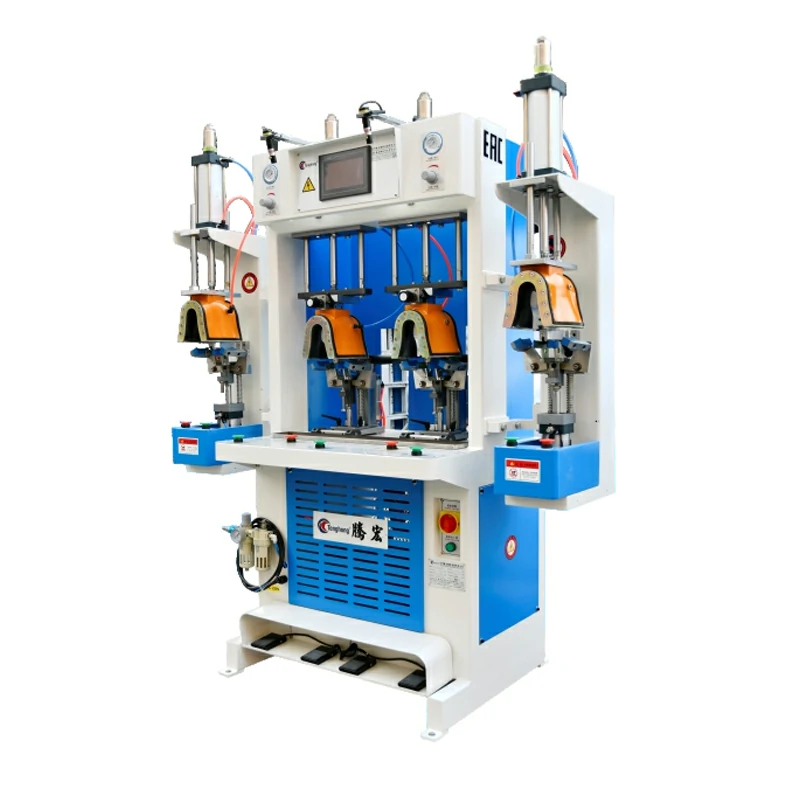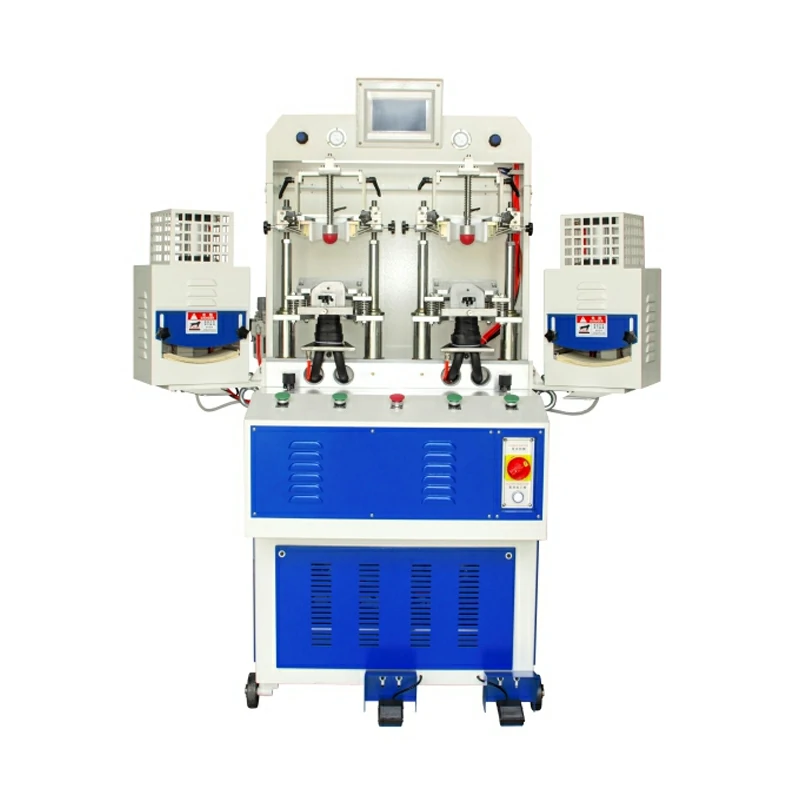
Choosing between a 7-pincer and a 9-pincer toe lasting machine comes down to the shoe types you produce, the size range you run, and the forming precision your customers require. A toe lasting machine with seven pincers is usually the right call for smaller, simpler footwear such as children’s shoes and women’s fashion styles, where stable output and cost control lead. A nine-pincer setup earns its place when your line includes men’s, athletic, safety, or custom leather shoes that need tighter, wrinkle-free forming around complex or larger toe shapes. Both configurations are available on modern automatic toe lasting machines, so the decision is less about which is ‘better’ and more about which matches your production program.
What the Pincer System Actually Does in Toe Lasting
Before comparing counts, it helps to understand what pincers do. In toe lasting, the upper is pulled and wrapped over the front of the last so the toe cap takes its final shape. The pincers are the gripping elements that hold the upper and apply controlled tension as it is drawn into position. The more pincers distributed around the toe, the more grip points there are and the finer the tension distribution becomes.
This matters because uneven tension is the main cause of wrinkles, bridging, and loose fits at the toe. A configuration with more pincers can hold the upper more completely around asymmetric or large toe profiles, while a leaner setup is often enough for smaller, more regular shapes. Pincer count is therefore one of several levers that determine forming quality, and it works together with how each pincer is controlled.
7-Pincer Configuration: Where It Fits
The seven-pincer layout is the practical choice for footwear with relatively simple, symmetrical toe construction. On machines such as those offered by TENGHONG, the 7-pincer setup is positioned for cost control and dependable output on mainstream styles.
Best-Suited Shoe Types
- Children’s shoes, where sizes are small and toe shapes are generally regular
- Women’s fashion footwear with lighter uppers and simpler toe profiles
- Standard casual styles produced in stable, high-volume runs
Cost and Throughput Profile
Because the 7-pincer configuration uses fewer gripping elements and a simpler mechanical envelope, it is typically the lower-investment option. For factories whose style mix does not demand fine tension control on complex toes, it delivers the required forming quality while keeping equipment spend and maintenance scope manageable. It is a sound choice when ‘consistently good enough’ is the real production target.
9-Pincer Configuration: Where It Earns Its Place
A 9-pincer toe lasting machine adds two extra grip points around the toe, and that difference shows up most on footwear where the upper must wrap tightly with no slack.
Tension Distribution and Wrinkle Control
With more pincers, upper tension is shared across a greater number of contact points. This reduces local over-stretch and helps eliminate the small wrinkles and folds that appear at the toe corners on demanding materials. The result is a smoother, tighter fit against the last — the kind of finish expected on premium leather and structured footwear.
Complex and Large-Size Toe Shapes
Nine pincers handle pointed, square, asymmetrical, and larger men’s sizes more completely than seven. For athletic shoes, safety boots, casual lines, and custom leather programs where the toe must hold a precise contour, the additional pincers give the machine more authority over the material without relying on operator skill to compensate.
7-Pincer vs 9-Pincer: A Direct Comparison
| Factor | 7-Pincer | 9-Pincer |
|---|---|---|
| Grip points around the toe | 7 | 9 |
| Typical shoe types | Children’s, women’s fashion, standard casual | Men’s, athletic, safety boots, custom leather |
| Tension distribution | Adequate for simple, regular toes | Finer, more even across complex shapes |
| Wrinkle control at toe corners | Good on light uppers | Strong on structured and large sizes |
| Investment level | Generally lower | Generally higher |
| Best production scenario | Stable, high-volume simple styles | Mixed or premium programs needing precise forming |
Pincer Force, Distance, and Angle: The Control Detail That Matters
Pincer number sets the upper limit on grip resolution, but daily results depend just as much on how each pincer is driven. On a modern automatic toe lasting machine, each pincer is operated by its own hydraulic cylinder, allowing independent adjustment of pulling force, pulling distance, and angle. That per-pincer control is what lets the machine adapt to irregular toe shapes rather than forcing every style through the same fixed motion.
In practice, this means a seven-pincer machine with good individual control can still form a small, delicate women’s shoe cleanly, while a nine-pincer machine earns its extra grip only when the shoe actually needs it. Count and control are partners, not substitutes.
Upper Materials and How They Respond to Pincer Count
Material behavior changes the equation. Soft mesh and thin synthetics are easy to draw and hold, so a seven-pincer layout is often sufficient. Stiff full-grain leather, reinforced safety-boot materials, and multi-layer constructions resist wrapping and tend to pucker at the corners; here the extra grip and even tension of nine pincers pay off. When you brief a supplier, name the actual upper materials you run, because the same pincer count performs differently across leather, mesh, and synthetic.
Changeover and Batch Flexibility in Mixed Production
Many shoe factories do not make one style all year. The useful question is how quickly the machine moves between programs. On controlled platforms, pincer profiles and process parameters for hundreds or thousands of shoe styles can be stored and recalled with a single key, so switching between a 7-pincer and 9-pincer program becomes a setting change rather than a mechanical rebuild. Where an optional 7/9-pincer arrangement is offered, the pincer layout can be memorized or mechanically adjusted to cover size changes from children’s shoes to large men’s footwear. This memory-based changeover is what keeps a single machine useful across a varied order book.
Balancing Production Volume and Forming Precision
There is often tension between throughput and finish. A seven-pincer machine focused on stable, simple styles can sustain steady output with minimal operator intervention, which suits cost-driven, high-volume programs. A nine-pincer machine adds capability for demanding footwear but is most valuable when that capability is actually used; running simple styles on it costs more without changing the result. The honest way to decide is to map your order book: if most pairs are simple and a small share are premium, a 7-pincer base with optional 9-pincer flexibility may cover both without over-investing.
Why Pincer Count Is Not the Only Decision
Other capabilities shape the outcome as much as the pincer count:
- PLC and memory control — parameters for many shoe styles are stored and recalled instantly, supporting fast changeover between configurations.
- Visual recognition (advanced models) — cameras identify last size, left/right orientation, and upper position, then plan the cementing path automatically for lower-manpower operation.
- Cementing system — a servo-driven glue pen traces complex edges with controlled dosage to limit overflow, while a glue injector lays a broad, flat bead for high-volume strength and speed. Either can be paired with a 7- or 9-pincer setup.
How to Choose Based on Your Production
Use the following questions to frame the decision before you speak with a supplier:
- What shoe types dominate your orders? Mostly children’s and women’s fashion points to 7 pincers; men’s, athletic, safety, or custom leather points to 9.
- What size range do you run? Wide spans from small to large men’s sizes benefit from the extra grip of nine pincers.
- What quality finish do your customers specify? If wrinkle-free, tight toe forming is a contract requirement, nine pincers reduce reliance on manual correction.
- What is your volume and budget balance? Seven pincers keep investment and maintenance lower where the simpler setup already meets quality.
What to Confirm With Your Supplier
Not every model offers both configurations, and some support an optional 7/9-pincer arrangement with a switchable profile. Ask which specific machines carry each option, how changeover is performed, and whether the same control platform covers both. Share your shoe types, size range, upper materials, target output, and required finish so the supplier can recommend the right pincer count and cementing system together.
When to Revisit Your Pincer Choice
Your pincer decision is not permanent. As your product line grows — for example, adding safety boots or custom leather to a children’s-shoe base — the forming demands change, and a configuration that was right at launch may stop being optimal. Review the decision whenever you introduce a new upper material, a larger size range, or a customer specification that calls for a tighter toe finish. Because the control platform supports both 7- and 9-pincer programs, moving between them is often a parameter and profile change rather than a new machine purchase, which keeps the upgrade path low-risk.
Frequently Asked Questions
Can one toe lasting machine switch between 7 and 9 pincers?
It depends on the model. Some machines are built around a fixed pincer count, while others offer an optional 7/9-pincer arrangement where the pincer profile can be memorized or mechanically adjusted. Confirm the specific model’s flexibility with the manufacturer before purchase.
Does a higher pincer count automatically mean better quality?
No. Nine pincers provide finer tension control, which helps on complex or large toes, but a seven-pincer machine produces excellent results on the shoe types it is designed for. Quality is set by the combination of pincer count, per-pincer control, and the upper material — not by the number alone.
Which pincer count is best for safety boots and athletic shoes?
A nine-pincer configuration is generally recommended for safety boots, athletic shoes, and other structured footwear, because the extra grip points hold the upper tightly around larger, more demanding toe shapes and limit wrinkles at the corners.
Is a 7-pincer toe lasting machine cheaper?
In most cases yes. The seven-pincer setup is the lower-investment option and is well suited to factories running stable, simpler styles where the forming quality already meets requirements. It is a practical way to control equipment cost without sacrificing consistent output.
Do these machines handle both glued and glueless processes?
Toe lasting machines are offered in both configurations: a traditional clamp-and-pull design where gluing is done manually, and an automatic gluing version with controlled adhesive application. Either can be combined with a 7- or 9-pincer setup depending on your line’s needs.
What technical information should I send when requesting a quote?
Provide your main shoe types, the full size range, upper materials such as leather, mesh, or synthetics, target daily output, required toe finish, and whether you prefer automatic gluing. This lets the supplier match both the pincer count and the cementing system to your program.
Conclusion
Neither pincer count is universally better — the right choice follows your shoe mix, size range, and quality expectations. Choose seven pincers for smaller, simpler, high-volume styles where cost and consistency lead; choose nine pincers for men’s, athletic, safety, and custom leather footwear that demands precise, wrinkle-free toe forming. Because both options sit on the same controlled, memory-equipped platform, the smarter move is to match the configuration to your actual production rather than to a specification sheet. To review the available toe lasting machine configurations and request a setup suited to your line, contact the team directly.