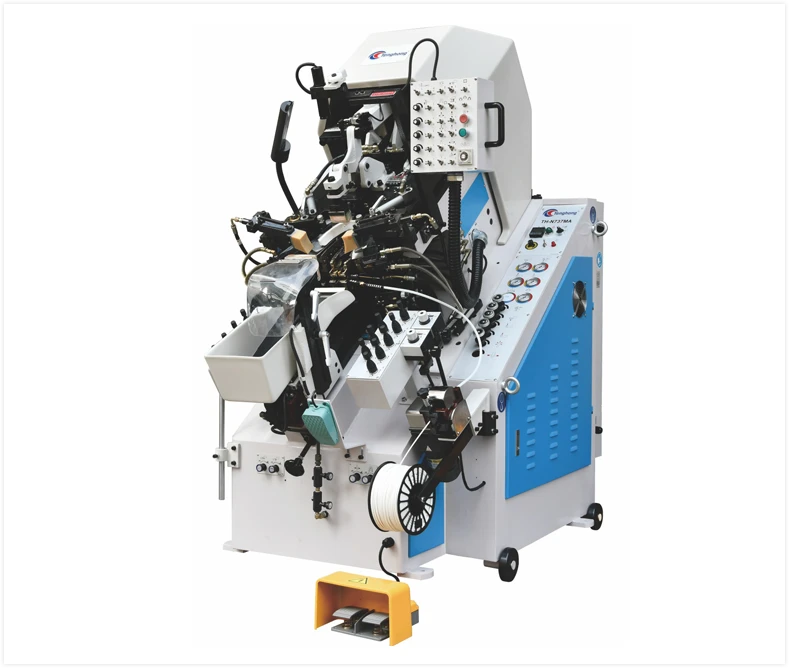
Achieving balanced shoe upper tension and a clean, wrinkle-free heel contour requires precise mechanical coordination across pincers, wipers, and adhesive dispensers. In modern footwear production lines, achieving this balance consistently depends heavily on how the lasting machinery controls clamp timing, multi-axis wiper travel, and bedding force. Utilizing a modern side and heel seat lasting machine consolidates what used to be multiple manual alignment stages into a single, synchronized operation, directly preventing loose collars, topline distortion, and uneven featherlines.
This guide outlines how modern lasting machinery balances tension across varying upper materials, details the mechanical sequence for heel seat formation, provides factory floor calibration guidelines, and presents key evaluation criteria for selecting machinery tailored to your assembly requirements.
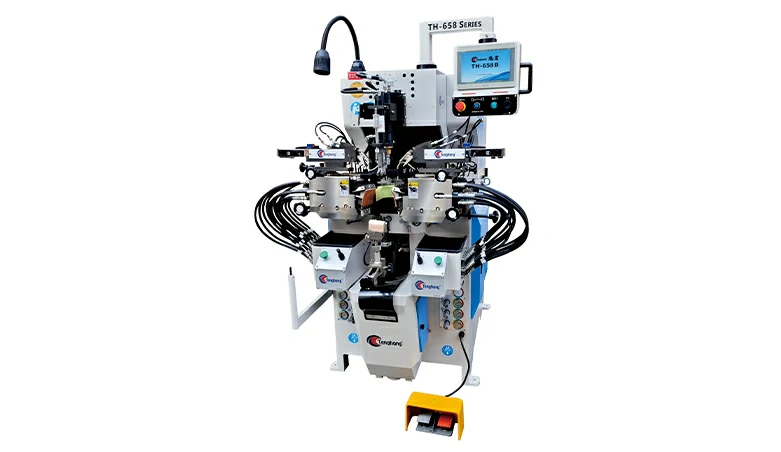
Mastering Tension and Heel Contours in Modern Shoe Construction
The waist (side) and heel seat represent the most complex geometries on any shoe last. Unlike the forepart, where tension pull follows a relatively uniform forward-and-down vector, the side and heel zones demand multi-directional strain to make the material conform to sharp lateral curves and concave arches.
When upper tension is unbalanced, lasting defects show up immediately:
- Topline Gap and Collar Flare: Insufficient side tension causes the shoe opening to gap away from the wearer’s ankle.
- Asymmetrical Featherlines: Uneven pulling forces between the medial (inner) and lateral (outer) sides pull the upper off-center relative to the insole edge.
- Heel Seat Bunches and Wrinkles: Excess material folding along the back curve without adequate wiper wipe-in and bedding pressure leaves bulky layers that prevent flush outsole bonding.
Integrating the waist pull and heel seat lasting into a unified workstation eliminates transfer distortion—a common defect when uppers are partially lasted at one station and manually repositioned at another.
Engineering Upper Tension: Mechanical Systems Behind Uniform Side Pulling
Controlling tension requires separating mechanical clamping force from material stretch characteristics. Modern side lasting systems use segmented pincer sets or continuous pulling bands that adapt to the asymmetrical profiles of left and right lasts.
Pincers Synchronization and Multi-Directional Clamping
Standard side lasting mechanisms incorporate independent pincer banks for the inner and outer waists. Because the medial arch is more pronounced than the lateral edge, the stroke distance and pull angle cannot be identical:
- Independent Stroke Regulation: Medial pincers require deeper angular travel to seat the upper snugly into the arch without pulling the topline out of true.
- Progressive Tensioning: Modern machines pull the material down in phased increments rather than a single sudden pull, allowing fibers in natural leather or synthetic substrates to relax into the last contours without tearing.
Preventing Material Distortion Across Leather and Synthetic Uppers
Different shoe upper constructions respond differently to mechanical tension:
| Material Type | Primary Tension Challenge | Machine Adjustment Focus |
| Full-Grain Leather | Natural grain variation and directional stretch | Progressive hydraulic/servo pull; localized stroke limits to prevent over-stretching the grain layer. |
| Synthetic Leather (PU/Microfiber) | Lower elasticity; risks tearing at stitch holes | Wider pincer jaw surfaces; reduced edge pull velocity to prevent localized rupture. |
| Engineered Mesh / Knitted Textiles | Elastic rebound and internal foam displacement | Controlled holding pressure; continuous band tension rather than narrow pincer clamping to avoid bite marks. |
Heel Seat Shaping: Wiper Geometry, Bedding Pressure, and Cement Placement
The heel seat lasting sequence must transform a cylindrical upper backform into a flat, well-defined foundation ready for outsole attachment. This requires precise alignment of three mechanical elements: the heel band, the wipers, and the bedding system.
Heel Seat Lasting Mechanical Sequence
| Step | Process Stage | Mechanical Action | Operational Objective |
| 01 | Last Clamping & Band Enclosure | The last is locked in place while a contoured heel band wraps tightly around the counter. | Holds the upper firmly against the last contours and prevents vertical counter slippage. |
| 02 | Adhesive Application | Internal hot-melt nozzles deliver a calibrated glue bead along the margin between the insole and upper. | Establishes precise cement placement before folding to prevent squeeze-out beyond the featherline. |
| 03 | Wiper Inward Stroke | Left and right wiper plates advance horizontally, cutting across the corner radius. | Folds the lasting margin flat against the insole while smoothing out corner material bunches. |
| 04 | Vertical Bedding Pressure | The bedding block descends, applying high vertical clamping force onto the wiped margin. | Flattens overlapping folds completely and cures the adhesive bond under sustained compression. |
Wiper Plate Stroke and Heel Bedding Synchronization
Heel seat wipers do not just push inward; they execute a compound curve-and-close motion. If the wipers advance before the upper is firmly clamped by the heel band, the counter material will creep upward, altering the intended back height. Conversely, if the vertical bedding head descends prematurely, it pinches wrinkles into the margin before the wipers finish flattening the edge. Modern systems control this transition down to fractions of a second.
Controlled Hot-Melt Adhesive Dispensing
Older lasting methods relied on manual tacks or pre-applied solvent cements. Contemporary cement heel seat lasting machine technology uses integrated hot-melt adhesive injectors. The key to clean lasting lies in nozzle cutoff precision: adhesive must stop dispensing before the wipers complete their inward stroke to prevent molten glue from squeezing past the featherline onto the finished upper.
Troubleshooting Common Side and Heel Lasting Defects on the Factory Floor
When lasting defects occur, machine operators often increase overall hydraulic pressure. However, excess pressure frequently damages the last or ruptures the upper without addressing the root cause. Use this diagnostic matrix to identify corrective adjustments:
| Defect Symptom | Probable Mechanical Cause | Corrective Machine Calibration |
| Wrinkles around heel curvature | Wiper plates closing too late relative to the heel band, or inadequate bedding pressure. | Advance wiper stroke timing; ensure wiper profiles match the heel radius of the last; check bedding cylinder pressure. |
| Asymmetrical topline / crooked backseam | Uneven pincer pulling force between medial and lateral side banks. | Rebalance independent side pincer stroke settings; verify pincer grip pads are free of glue buildup. |
| Upper material tears along featherline | Excessive pulling stroke or sharp wiper edges pinching the margin. | Reduce initial pincer pull depth; inspect wiper edges for burrs; adjust wiper clearance height over the insole. |
| Glue squeeze-out at the upper-sole seam | Adhesive volume set too high or injection point too close to the featherline. | Shift glue nozzle path inward by 1.5–2.0 mm; shorten adhesive delivery duration; verify nozzle temperature. |
| Loose arch / hollow waist fit | Insufficient side clamping depth or misaligned side pressure pads. | Adjust side band or pincer inward travel angle to maintain direct contact with the last arch concavity. |
Specifying a Side and Heel Seat Lasting Machine: B2B Evaluation Criteria
Selecting lasting machinery involves matching the drive mechanism and tooling flexibility to your factory’s production volume, SKU turnaround frequency, and footwear categories.
1. Drive Mechanisms: Hydraulic vs. Pneumatic vs. Servo-Controlled
- Hydraulic Systems: Provide high, consistent clamping and bedding forces suitable for heavy work boots, thick leathers, and formal dress shoes requiring sharp featherlines.
- Pneumatic Systems: Suited for lighter footwear and casual styles. While responsive, pneumatic cylinders can experience pressure fluctuations if the central shop-air supply is inconsistent.
- Servo-Driven Systems: Provide digital control over pincer positions, wiper speeds, and pressure stages. They allow operators to store and recall exact recipe parameters for distinct shoe styles, reducing setup times during model changeovers.
2. Tooling Changeovers and Last Compatibility
In facilities handling diverse shoe profiles—from children’s footwear to high-top boots—tooling flexibility directly determines machine utilization. Plant engineers should assess:
- Wiper Quick-Change Mechanisms: Can operators change wiper plates for varying heel radii without requiring extensive machine disassembly?
- Heel Band Adaptability: Does the band accommodate narrow women’s heel seats as well as wide athletic lasts without leaving gap marks on the counter?
- Vertical and Horizontal Adjustment Range: The machine must provide sufficient travel along the Z-axis to accommodate varying heel heights, particularly when switching between flat sneakers and raised dress heels.
When upgrading an existing line, evaluating high-performance models from established manufacturers like Tenghong allows production teams to match specific hydraulic configurations, wiper travel geometry, and automated adhesive systems to their exact footwear mix.
Key Takeaways
- Defect Elimination via Process Integration: Combining waist pulling and heel seat shaping into a single machine cycle prevents upper shifting, collar distortion, and misaligned backseams.
- Material-Dependent Tensioning: Natural leathers require progressive, stroke-limited pulling to protect the grain, while synthetics and technical meshes benefit from broader clamping surfaces to prevent localized stitch rupture.
- Wiper-Bedding Synchronization: A flat, bond-ready heel seat depends entirely on the timing between horizontal wiper sweep and vertical bedding compression.
- Diagnostics Over Pressure: Most lasting defects stem from mechanical misalignment or stroke mistiming rather than insufficient global pressure. Increasing hydraulic force without diagnosing stroke timing risks damaging tooling and tearing uppers.
Frequently Asked Questions (FAQ)
What is the primary operational difference between a standalone heel seat laster and a combined side and heel seat lasting machine?
A standalone heel seat laster only closes the back counter, requiring the waist to be lasted either beforehand or afterward on a separate machine. A combined side and heel seat lasting machine holds the last securely while simultaneously tensioning the waist uppers and wiping the heel seat. This eliminates secondary handling, reduces positioning errors, and ensures that tension across the arch transitions smoothly into the heel cup.
Can a single side and heel seat lasting machine process both athletic sneakers and formal leather shoes?
Yes, provided the machine features adjustable tension controls, interchangeable wiper sets, and customizable adhesive paths. Athletic shoes with synthetic uppers and flat profiles require lower pulling forces and wider wiper sweeps. Formal leather shoes require higher bedding pressures and dedicated wiper profiles tailored to pronounced heel counters. Tooling compatibility should always be verified against the manufacturer’s range specifications.
How often should lasting wipers and heel bands be inspected or replaced?
Wiper plates and heel bands should be visually inspected daily for adhesive contamination, burrs, or surface wear. Hardened adhesive on wipers can score leather uppers, while worn heel bands can cause uneven counter pressure. In high-volume facilities, wipers should be cleaned and calibrated regularly, with mechanical wear components replaced based on shift cycles and material abrasiveness.