In large-scale footwear manufacturing, the toe lasting operation determines structural consistency, vamp tension balance, and downstream sole bonding strength. Selecting an automatic toe lasting machine for high-volume lines requires balancing cycle time, mechanical pulling accuracy, adhesive delivery stability, and tooling changeover speed.
This guide evaluates five representative machine architectures across hydraulic and servo-driven configurations, outlines essential engineering selection criteria, and details the technical inputs required to integrate high-efficiency lasting equipment into continuous production lines.
Why Toe Lasting Dictates Yield and Efficiency in Footwear Mass Production
Toe lasting—also referred to as forepart lasting—is the mechanical process of drawing the shoe upper tightly over the toe section of the shoe last and securing it to the insole using thermoplastic cement. In continuous footwear production, this workstation represents a primary bottleneck for three engineering reasons:
- Dimensional Uniformity Across Shifts: Manual or semi-automated lasting creates inconsistent tension across asymmetrical shoe patterns, causing uneven toe spring, crooked feather edges, and skewed cap seams. An automated multi-pincer cycle eliminates operator fatigue variance by applying programmable, repeatable tension profiles.
- Adhesive Application Accuracy: Over-cementing causes hot-melt adhesive to bleed onto visible vamp materials or spill beyond the feather line, requiring labor-intensive manual buffing. Under-cementing results in edge separation during sole attachment. Automated cementing systems place a measured trace of adhesive precisely beneath the wipers before the stroke completes.
- Upper Tear and Stress Management: Different shoe upper materials—such as thick full-grain leather, engineered flyknit mesh, and synthetic microfibers—exhibit distinct tensile limits. Modern advanced automatic toe lasting machines feature independent pressure regulation per pincer to pull delicate areas without ripping seams or overstretching grain surfaces.
Evaluation Framework: What Makes a Toe Lasting Machine Fit for High-Volume Output?
Evaluating equipment for mass production requires looking past nominal rated output to assess how machine components respond under sustained mechanical stress. Production engineers should examine four primary subsystems:
| Evaluation Dimension | Core Engineering Focus | Technical Requirement for Mass Production |
| 1. Pincer Mechanics | Grip stability & multi-axis movement | Independent stroke, tension, and angle adjustments per pincer jaw |
| 2. Wiper & Band Systems | Feather edge flatness & corner wrap | Synchronized heated wiping plates with temperature-controlled Teflon band wrap |
| 3. Cementing Delivery | Adhesive volume & margin control | Modulated internal hot-melt extrusion trace with anti-drool thermal cutoff |
| 4. Line Reconfiguration | Tooling swap & line balancing | Modular quick-change wiper assemblies with digital multi-parameter recipe memory |
1. Pincer Gripping and Trajectory Control
Industrial machines incorporate between 7 and 9 pincers positioned radially around the toe head. High-volume setups require independent pincer positioning, enabling operators to adjust individual pincer grip angles, vertical draw depths, and horizontal pull tensions. Quick-release pincer mounts drastically reduce downtime during routine jaw cleaning and pad replacement.
2. Wiper Assembly and Teflon Band Wrapping
Once the pincers stretch the upper, heated wipers sweep forward to press the upper allowance flat against the insole. For complex toe profiles, a flexible, temperature-regulated Teflon band wraps around the perimeter ahead of the wipers. This secondary support ensures uniform corner compression and prevents leather gathering or wrinkling along the feather edge.
3. Programmable Hot-Melt Injection
Industrial toe lasting relies on internal nozzle systems that inject precise traces of thermoplastic polyester or polyamide cement. Key engineering factors include:
- Constant-temperature glue pot heating to eliminate viscosity drift.
- Anti-drool shut-off nozzles to prevent contamination of the shoe bottom.
- Adjustable nozzle stroke to track variable last curvature without manual nozzle replacement.
4. Changeover Tooling and Recipe Storage
High-mix mass production operations cannot afford extended changeover periods when alternating shoe sizes or styles. Look for machines with motorized last-support positioning, modular wiper plates, and programmable logic controllers (PLCs) capable of storing multi-parameter shoe recipes.
Top 5 Automatic Toe Lasting Machines for Footwear Mass Production
The five machines detailed below represent the dominant mechanical, hydraulic, and servo configurations used in commercial footwear plants worldwide.
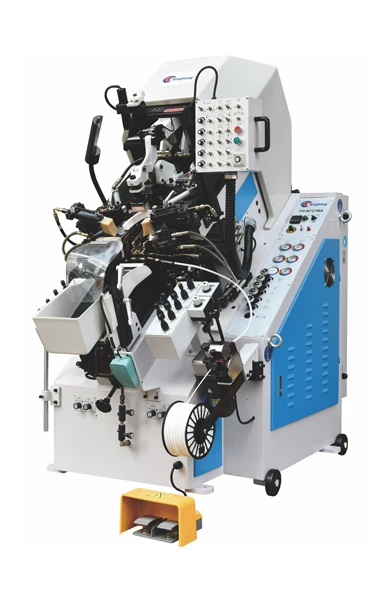
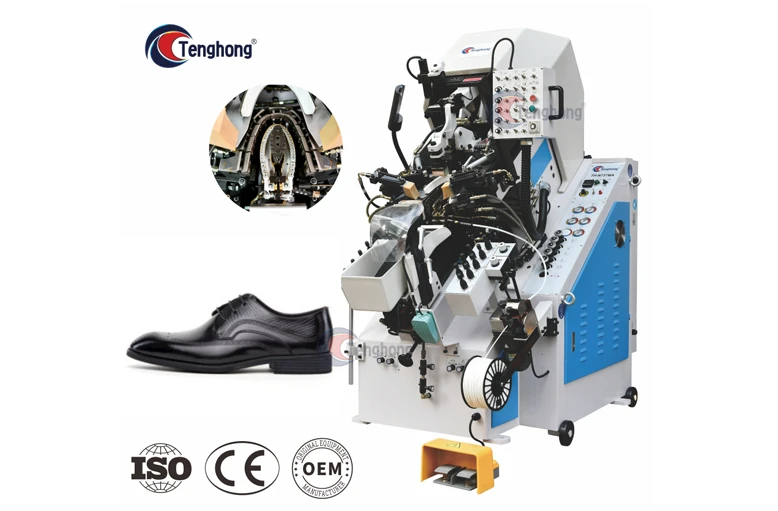
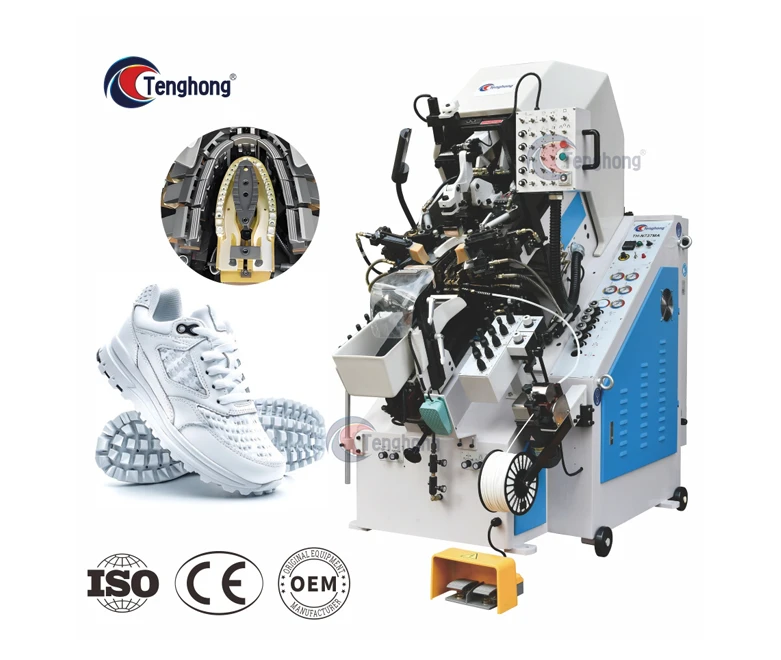
1. Tenghong Computerized Multi-Pincer Automatic Toe Lasting Machine – Best Overall for High-Mix Mass Production
The Tenghong automatic toe lasting machine utilizes an advanced PLC architecture combined with an independently adjustable multi-pincer array, making it particularly effective for factories running diverse product lines across athletic, casual, and formal footwear styles.
- Engineering Highlights:
- Independent Pincer Calibration: Each pincer assembly features individual hydraulic stroke and pressure regulation, allowing precise tension grading between the toe tip and ball break areas.
- Precision Cementing Trace: Integrated automatic glue injection follows the inner wiper contour, depositing an even bead of hot-melt cement directly onto the bonding zone without manual touching-up.
- Digital Recipe Memory: Stores multi-point operational profiles (pincer sequence, wiper dwell time, pressure curve) for quick style transitions.
- Note: Exact output ratings (pairs per 8-hour shift), hydraulic reservoir capacity, and motor kilowatt ratings depend on specific factory configurations and must be confirmed with the manufacturer.
- Mass Production Advantages: Rapid tool-less wiper adjustments and automated last-support positioning minimize changeover downtime, maintaining line balance during multi-style production runs.
- Operational Considerations: Requires standard pneumatic and three-phase hydraulic connections, with routine inspection needed for hydraulic filter elements and glue injector seals.
2. Heavy-Duty 9-Pincer Hydraulic Toe Lasting Machine – Best for Work Boots & Heavy Leather
Engineered specifically for heavy work boots, military footwear, and rigid hiking shoes, this configuration utilizes high hydraulic system pressure to overcome thick full-grain leather, rubber rands, and reinforced steel toe caps.
- Engineering Highlights:
- High-Clamping Force Pincers: Nine oversized alloy jaws pull heavy leather stock up to 2.5 mm thickness without slippage or surface marring.
- Dual-Stage Last Elevation Support: A reinforced hydraulic cylinder provides substantial upward thrust to lock steel toe lasts securely against the wiper plate.
- Reinforced Wiper Carriers: Heavy cast-steel wiper arms withstand extreme forward shear force without structural deflection.
- Mass Production Advantages: Prevents structural spring-back in heavy leather vamps and consistently forces rigid counter-lining materials flush against safety box toes.
- Operational Considerations: Higher power consumption and larger physical footprint than lighter machines; hydraulic oil cooling loops are recommended in high-ambient-temperature plants.
3. High-Speed 7-Pincer Automatic Cement Toe Lasting Machine – Best for High-Velocity Athletic Footwear
Configured for high-throughput athletic sneaker and running shoe lines, this 7-pincer unit prioritizes rapid mechanical cycle times on standardized, flexible synthetic materials and flyknit mesh uppers.
- Engineering Highlights:
- Streamlined 7-Jaw Array: Arranged to match standard rounded athletic lasts, reducing mechanical linkage complexity and lowering cycle times.
- Fast-Acting Pneumatic-Hydraulic Assist: Hybrid actuator mechanisms cycle pincer stroke, glue ejection, and wiper press within tight time windows.
- Low-Friction Teflon Wrapping: Specialized heated bands glide smoothly over synthetic materials to eliminate synthetic surface scorching or mesh snagging.
- Mass Production Advantages: Delivers optimal throughput when handling uniform, high-elasticity uppers on dedicated single-style lines.
- Operational Considerations: Less versatile for sharp-pointed dress shoes or asymmetric lasts that require localized micro-adjustments around the outer ball region.
4. Servo-Driven Precision Micro-Toe Lasting System – Best for Premium Dress Shoes & Pointed Lasts
Replacing conventional hydraulic cylinders with multi-axis digital servo motors, this system delivers sub-millimeter positional accuracy for luxury dress footwear, high-heeled women’s shoes, and extreme pointed-toe lasts.
- Engineering Highlights:
- Closed-Loop Servo Control: Digital servos monitor torque and linear displacement in real time, preventing delicate, thin-gauge calfskin from tearing.
- Micro-Wiper Contouring: Finely honed wiper edges trace narrow toe profiles without overlapping or crushing feather edges.
- Precise Micro-Dosing Injection: Dispenses minimal cement volumes to eliminate bleed-through on porous leather and suede outsoles.
- Mass Production Advantages: Achieves zero-defect surface quality on premium leather lines where rework or surface cleaning costs are prohibitive.
- Operational Considerations: Higher initial capital investment; requires cleanroom-grade electrical cabinet ventilation and in-house technical staff trained in servo drive diagnostics.
5. Hybrid Semi-Rigid Toe & Side Lasting Combination Machine – Best for Compact Lean Cells
Designed for footwear facilities with limited floor space or smaller lean manufacturing cells, this hybrid unit integrates toe lasting with preliminary ball-and-side waist lasting in a single operator workstation.
- Engineering Highlights:
- Dual-Zone Lasting Mechanism: Features a compact toe pincer array paired with lateral pulling bands that wipe the waist area immediately following the toe stroke.
- Single-Clamping Sequence: Completes forepart and side alignment in one seating of the shoe last, eliminating intermediate staging racks.
- Compact Base Footprint: Integrates hydraulic pump and pneumatic regulators within an enclosed cabinet measuring roughly 30% smaller than separate units.
- Mass Production Advantages: Reduces WIP (work-in-progress) buffer inventory and cuts intermediate handling labor on continuous assembly tracks.
- Operational Considerations: Tooling changes take longer because both toe and waist wiping plates must be recalibrated simultaneously during style changeovers.
Engineering Comparison: Output, Pincer Count, and Process Compatibility
The table below outlines mechanical configurations, drive principles, and production characteristics to help factory engineering teams evaluate suitability:
| Machine Architecture | Primary Drive System | Pincer Setup | Target Footwear Categories | Relative Changeover Speed | Production Environment |
| Tenghong Computerized Multi-Pincer | Electro-Hydraulic + PLC | Multi-Pincer (Independently Adjustable) | Athletic, casual, dress, and light outdoor | Fast (Menu-driven with digital last memory) | High-volume multi-style OEM/ODM factories |
| Heavy-Duty 9-Pincer Hydraulic | High-Pressure Hydraulic | 9 Heavy-Grip Alloy Pincers | Work boots, safety shoes, heavy leather boots | Moderate (Mechanical jaw & stop adjustments) | Dedicated workwear & outdoor boot lines |
| High-Speed 7-Pincer Cementing | Hydro-Pneumatic Hybrid | 7 Radial Pincers | Lightweight sneakers, knit running shoes | Moderate (Standardized tooling setup) | High-velocity single-style athletic lines |
| Servo-Driven Precision System | Multi-Axis Digital Servo | Multi-Servo Floating Pincers | Luxury dress shoes, high heels, pointed toes | Fast (Fully programmable digital profiles) | High-end fashion & luxury leather facilities |
| Hybrid Toe & Side Lasting | Compact Hydraulic | Multi-Pincer + Side Bands | Casual sneakers, basic cemented shoes | Slower (Dual-zone mechanical adjustment) | Compact lean cells & space-constrained plants |
How to Match the Right Machine to Your Production Floor (Avoid These 4 Mistakes)
Investing in shoe lasting equipment involves multi-year capital expenditure. Avoid these four common operational oversights during the technical evaluation process:
1. Specifying Pincer Count Without Mapping Last Radii
A common misconception is that a 9-pincer machine is inherently superior to a 7-pincer configuration for every shoe type. While 9 pincers are essential for wrapping broad, blunt toe caps or rigid work boots, they can create physical interference around narrow or sharp-pointed toe shapes. Inspect last geometry: sharp dress lasts often perform better with fewer, highly articulate pincers rather than crowded jaw configurations.
2. Disregarding Adhesive Viscosity and Thermal Cut-Off Times
Matching the machine’s hot-melt injection system to the factory’s adhesive chemistry is critical. Thermoplastic polyester adhesives require precise thermal control; if the glue pot temperature fluctuates by more than ±3°C, adhesive viscosity changes, resulting in inconsistent extrusion beads or clogged nozzles. Ensure the machine features independent heated line zones and automatic temperature drop modes during production pauses.
3. Overlooking Real-World Changeover Requirements
A machine capable of high theoretical cycles per hour can still degrade daily line output if tooling adjustments take two hours between size or style runs. For factories handling frequent small-batch OEM orders, prioritize machines with quick-release wiper assemblies, tool-free pincer repositioning, and recipe memory.
4. Ignoring In-House Utility Infrastructure
High-pressure hydraulic toe lasting machines generate substantial heat during multi-shift continuous runs. In tropical or non-air-conditioned plant environments, verify whether the machine requires external chiller loops or features an integrated oil-cooling heat exchanger to prevent hydraulic seal degradation.
Key Takeaways
- The Process Bottleneck: Toe lasting dictates upper symmetry, feather line tightness, and sole bonding durability; automating this step is critical for continuous mass-production consistency.
- Mechanical Fit Over Raw Speed: Selecting between 7-pincer, 9-pincer, hydraulic, and servo platforms must be driven by upper material rigidity, last radius, and style variance rather than theoretical cycles alone.
- Thermal & Fluid Control: Consistent cement extrusion requires stable glue pot temperature control and anti-drool nozzles to avoid costly upper cleanup and scrap.
- Operational Flexibility: For high-mix footwear manufacturing, fast tooling changeovers and PLC recipe storage provide higher effective daily yields than rigid high-speed systems.
Frequently Asked Questions About Industrial Toe Lasting Machines
What is the typical daily output of an automatic toe lasting machine in mass production?
In a standard 8-hour shift, industrial automatic toe lasting machines typically yield between 1,200 and 2,000 pairs, depending on operator proficiency, shoe upper material, adhesive curing speed, and line feeding logistics. Actual capacity must be confirmed based on specific factory workflow and shoe construction.
What is the main difference between hydraulic and servo-driven toe lasting machines?
Hydraulic machines rely on pressurized fluid systems to generate high, consistent clamping and wiping force, making them durable, cost-effective, and ideal for heavy leathers and standard mass production. Servo-driven machines utilize digital electric actuators to deliver micro-precise tension profiling and torque control, which prevents tearing on delicate, high-end materials but involves higher initial machinery investment.
Can a single automatic toe lasting machine handle both leather dress shoes and knit athletic sneakers?
Yes, provided the machine features independent pincer pressure regulation, adjustable wiper stroke depth, and programmable cycle parameters. Switching between stiff leather and elastic synthetic mesh requires adjusting pincer grip pressure, changing the Teflon band profile, and modifying adhesive delivery settings.
How often do pincers and Teflon bands require maintenance or replacement?
In multi-shift mass production lines, pincer jaws should be cleaned daily with wire brushes to remove adhesive build-up and inspected weekly for serration wear. Teflon bands typically require replacement every few weeks to months, depending on operating temperatures, wiper friction, and daily throughput volume.