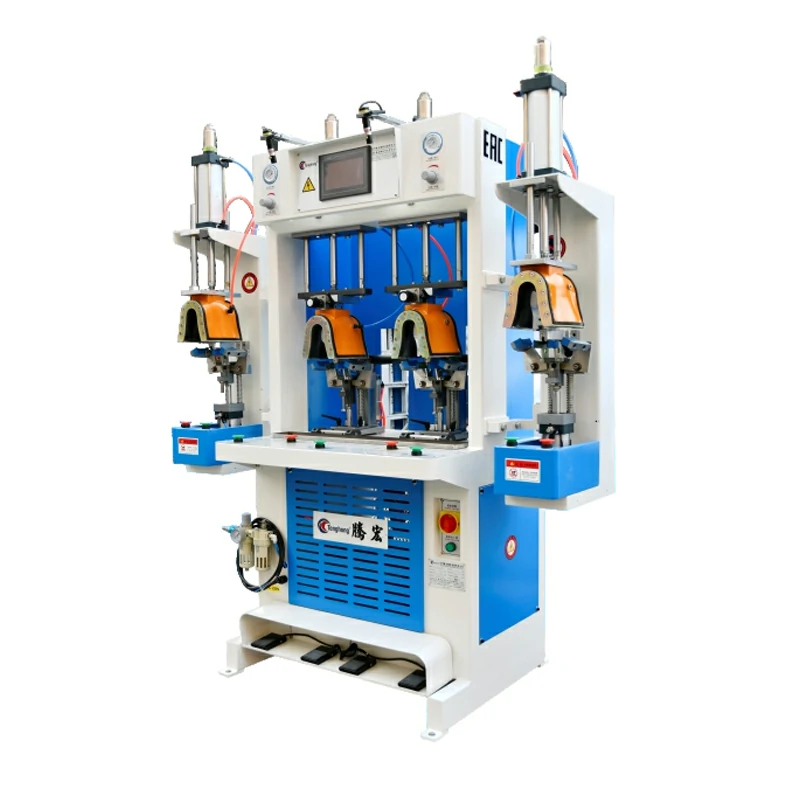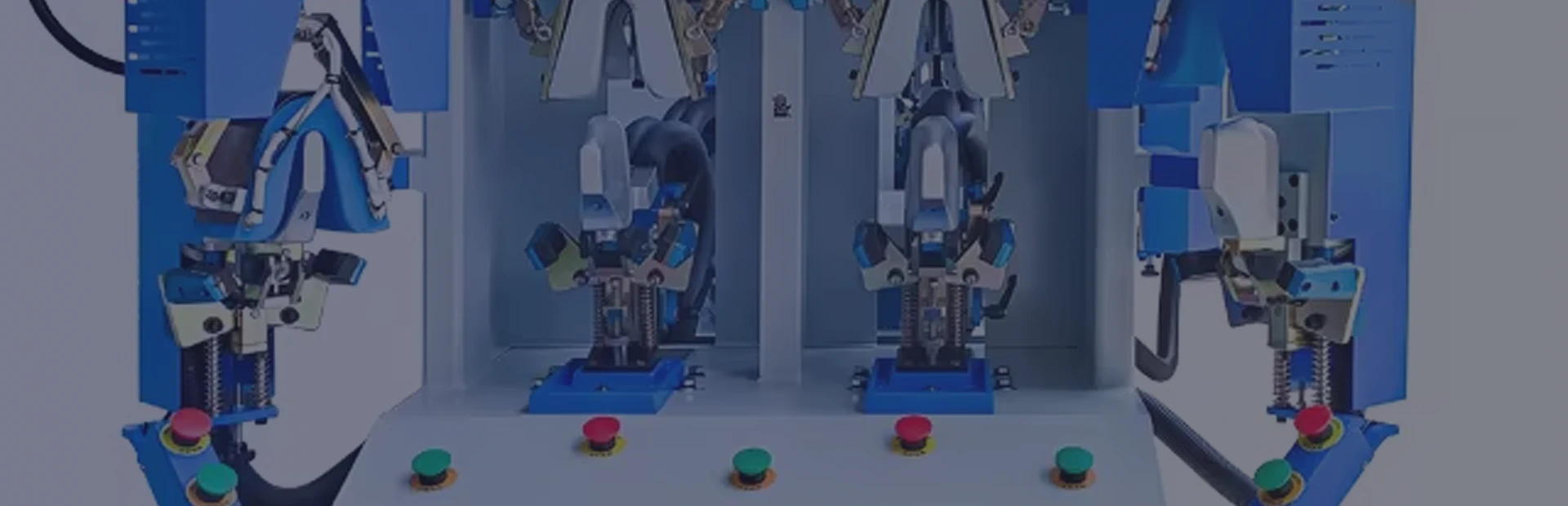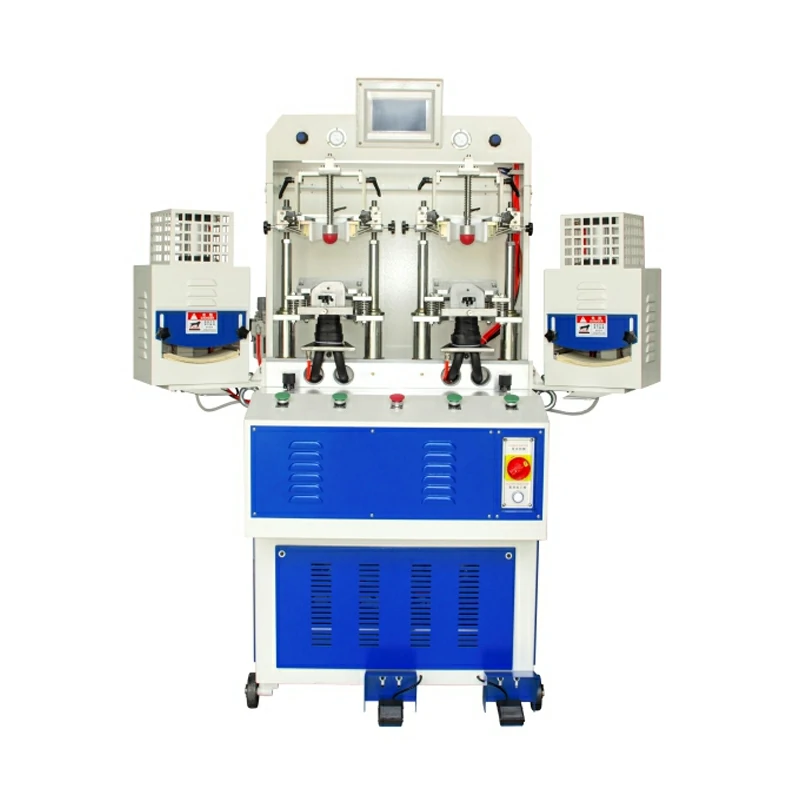
In automatic toe lasting, a glue injector meters and deposits adhesive through a nozzle or pressure-driven head, while a servo glue pen applies it with a servo-actuated tip that follows a programmed path and controls the start, stop, and dose at each point. The servo pen generally gives finer path control and lower glue waste on complex or partially bonded areas; the injector is often simpler and faster for broad, open bonding zones. Both can be integrated into the same automatic toe lasting machine, so the choice comes down to the precision your shoe program requires and how much adhesive waste you are willing to accept. This article compares the two applicator types, explains where each performs best, and shows what to verify when you source a toe lasting machine.
What “Glue Application Method” Means in Automatic Toe Lasting
In modern lasting, cementing is not a separate manual step — it is built into the machine cycle. The applicator is the subsystem that actually lays the adhesive onto the insole forepart or upper margin before the pincers pull the toe into shape. Because the toe bond sets the ceiling on finished quality, the applicator’s accuracy decides whether the glue film is even, whether it stays within the margin, and how much adhesive is spent per pair. When buyers compare an automatic cementing system, the injector-versus-pen question is really a question about how precisely the machine can place and meter glue.
How a Glue Injector Works
A glue injector meters and dispenses adhesive through a nozzle, typically driven by air pressure, a pump, or a valve. It lays down a controlled volume along a set line or zone, often as a continuous or pulse-metered bead. This approach is common on high-throughput lines where a relatively uniform deposit across an open area is enough to do the job.
Strengths of Injector-Style Application
- Mechanically simple, with fewer moving parts at the dispensing tip.
- Fast deposit across large, open bonding zones.
- Lower upfront complexity for straightforward shoe programs.
Limitations to Watch
- Path control leans on a fixed nozzle position or simple motion, so it is less able to vary the dose along an irregular edge.
- It can over-apply at corners and under-apply on detailed zones, raising both waste and defect risk.
- On small or shaped toe caps, the extra deposit is pure waste that must later be cleaned or concealed.
How a Servo Glue Pen Works
A servo glue pen is a servo-actuated applicator whose tip position and dispensing are driven by the machine’s control system. It follows a programmed trajectory and modulates glue at each point, starting and stopping precisely where the bond needs to be. This is the same control philosophy behind servo and PLC based trajectory tracking: the machine knows where the insole edge is and plans the cementing path from shoe size and type rather than laying a fixed bead.
Strengths of Servo Pen Application
- Path-accurate dosing that follows pointed, square, or asymmetrical toe shapes.
- Per-point dose control reduces both overflow and shortage.
- Lower adhesive waste and consistent results across sizes when parameters are stored as recipes.
Limitations to Watch
- More sophisticated control and mechanics than a basic injector head.
- Higher equipment complexity and, usually, higher upfront cost.
- Depends on accurate style recipes and, on advanced systems, on reliable vision data.
Glue Injector vs Servo Glue Pen — Side-by-Side
| Factor | Glue Injector | Servo Glue Pen |
|---|---|---|
| Motion control | Fixed nozzle / simple indexed motion | Servo-driven tip along a programmed path |
| Dose precision | Volume-controlled at the head | Per-point modulation along the path |
| Glue waste | Higher on detailed or small shapes | Lower, follows only the bonded zone |
| Best shoe types | Simple, regular, high-volume toes | Irregular, premium, or mixed-size programs |
| Changeover | Manual or coarse adjustment | Recipe recall for each style |
| Maintenance | Fewer moving parts at tip | More calibration of servo and tip |
| Upfront cost | Lower | Higher |
| Complex-toe suitability | Limited | Strong |
Precision and Waste — Why the Difference Matters for Adhesion
The practical risk in toe cementing is always the same pair of failures: overflow, where too much adhesive squeezes past the margin and stains the upper, and shortage, where too little leaves the upper under-bonded and prone to delamination. An injector that cannot vary dose along the edge tends to over-apply to stay safe, which raises waste. A servo pen that doses per point targets only the bonded region, which is why precise control of glue volume and temperature is the capability that actually moves defect rates. On the TENGHONG toe lasting machine, the documented precision cementing controls both glue volume and temperature, which is the same problem these two applicator styles are trying to solve from different angles.
Temperature control deserves specific attention because adhesive behavior changes with it. A glue that is too cool may not wet the surface evenly; one that is too warm may string, drip, or cure before the upper is set. An applicator that can hold a stable temperature through a long production run protects consistency in a way that ambient, unheated deposit cannot. For buyers, this is a specification worth asking about directly rather than assuming it is handled.
Matching the Applicator to Your Adhesive and Materials
Applicator choice does not exist in isolation from the adhesive and the upper. Water-based, solvent-based, and hot-melt adhesives differ in viscosity and open time, and leather, synthetic, mesh, and structured materials accept and hold glue differently. A simple injector can be perfectly adequate when a single adhesive is run across a stable style mix, because the deposit is repeatable once tuned. A servo pen earns its place when the line must switch adhesives, materials, or toe geometries without re-tuning by hand, because the path and dose are defined in software rather than set at the nozzle. The right answer follows from your material range, not from a generic “newer is better” assumption.
This also separates prototyping from volume production. In a prototype or custom run, an operator can tolerate a less precise applicator because volumes are low and adjustments are frequent. In steady production, the same imprecision becomes a daily source of scrap and rework. The applicator that looks expensive on paper often pays back through reduced adhesive consumption and fewer rejected toes once the line runs at target volume.
What TENGHONG’s Precision Cementing System Documents
When evaluating a precision cementing technology supplier, it helps to separate the control system from the physical applicator head. TENGHONG’s documented cementing uses a PLC control system with servo drive technology to trace the insole edge by shoe size and type and automatically plan the cementing path, plus precise control of glue volume and temperature to avoid overflow and shortage. The system can store parameters for hundreds or thousands of shoe styles and recall them with a single key, and advanced versions add a visual recognition system that identifies last size, left/right orientation, and upper deviation to set the cementing trajectory. In control terms, that is a path-controlled, metered application philosophy — the same family of benefits associated with a servo-driven glue pen. The specific applicator hardware (injector head versus pen-style tip) is a configuration detail to confirm with the supplier; the documented control layer is what delivers the consistency buyers care about.
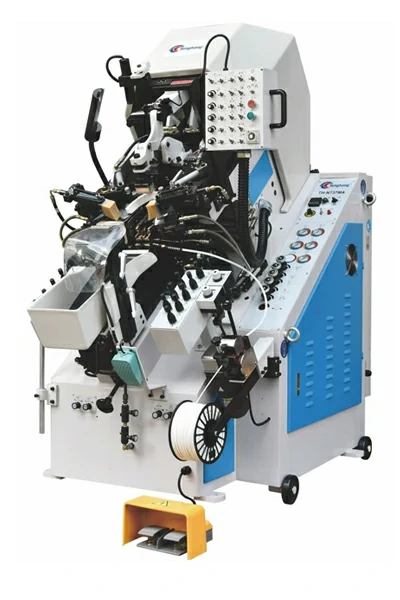
How to Specify Applicator Requirements When Sourcing a Toe Lasting Machine
The safest way to avoid a mismatch is to describe your real production in the request for quotation, then ask the supplier to map it to a configuration. Share your shoe types, size range, adhesives, target output, and how often styles change, and request evidence rather than a label.
Questions to Ask a Supplier or Manufacturer
- What type of glue applicator does the machine use, and can dosing be adjusted per zone?
- What is the controllable range for glue volume and temperature, and how is it set per style?
- Which adhesives and upper materials has the cementing system been validated with?
- How are style recipes stored, and how fast is changeover between them?
- Is trajectory tracking standard or optional, and is visual recognition available?
- What training, documentation, and support cover the cementing function after installation?
When you write the technical requirements, include your acceptable bond-width tolerance, the adhesive specification, expected production volume, and any OEM or custom program needs. A capable manufacturer or supplier should respond with a concrete configuration and quality control approach rather than a generic model number.
Common Misconceptions About Automatic Glue Application
Several beliefs about automatic cementing lead buyers to the wrong machine. “More glue means a stronger bond” is false — excess adhesive causes overflow and can itself trigger delamination. “Any automatic system is the same” ignores the control philosophy that separates a fixed injector from a servo-planned path. “A servo pen is always necessary” is equally wrong; a stable, simple program may not need it. And “manual cementing is fine once you scale” overlooks the consistency risk that automatic, metered application exists to remove.
Frequently Asked Questions
What is a glue injector in toe lasting?
A glue injector is an applicator that meters and dispenses adhesive through a nozzle, usually driven by air pressure, a pump, or a valve. It lays a controlled volume along a set line or zone and is valued for simplicity and speed on open bonding areas.
What is a servo glue pen?
A servo glue pen is a servo-actuated applicator whose tip position and dispensing are controlled by the machine. It follows a programmed trajectory and modulates glue at each point, giving precise start, stop, and dose along the bonded region.
Which applicator suits small or detailed toe shapes?
A servo glue pen is generally better for detailed, irregular, or small toe caps because it can vary the dose along the path. An injector tends to over-apply on those shapes to avoid shortage, increasing waste.
Does applicator type affect glue waste and cost?
Yes. A servo pen targets only the bonded zone and lowers per-pair adhesive use, while a simpler injector often over-applies on complex shapes. Over a production run, that difference shows up directly in material cost.
Can one toe lasting machine support both methods?
In many designs the applicator is a configurable subsystem, but the control capability behind it — trajectory tracking and dose control — is what determines how precisely either method runs. Confirm the exact option with the supplier rather than assuming both are available on every model.
What should I specify when requesting a quote?
Share your shoe types, size range, adhesive specification, required bond tolerance, target output, and style-change frequency. Those details let a supplier recommend the right applicator and control configuration instead of a one-size-fits-all machine.
Conclusion
A glue injector and a servo glue pen solve the same problem — placing adhesive accurately before the toe is formed — but they do it with different control depth. The injector wins on simplicity and speed for stable, open-area programs; the servo pen wins on path accuracy, lower waste, and repeatability for complex or changing programs. When you evaluate toe lasting equipment, look past the label and examine the control system: trajectory tracking, dose and temperature control, recipe storage, and supplier support. To see how these capabilities are built into a production-ready machine, review the TENGHONG footwear production line and contact the team with your specific adhesive, material, and volume requirements.